
Fuel price rising headlines are back—and fleets feel it first. When prices jump in a matter of days, the difference between “good enough” fuel tracking and real fuel management shows up immediately on the P&L. For commercial fleets, diesel price volatility is no longer a seasonal annoyance; it is a structural risk that requires a technological response.
The goal of this guide is to turn volatility into a practical, repeatable operating system: baseline, detect loss, reduce waste, and govern spend. By combining the deep telematics insights of Samsara with the robust transaction data of Shell Fleet Solutions, and utilizing Fleevo as the central orchestration layer to automate these data streams, operators can move beyond reactive budgeting. This playbook highlights how fleets can build stronger controls and turn data into a durable competitive advantage.
What changed recently and why fleets should care
The energy landscape of 2026 has introduced a new era of "micro-spikes." Unlike the predictable cycles of the past, current diesel price volatility is driven by tighter refining margins and shifting global trade routes. According to the IEA Oil Market Report for February 2026, supply chain pressures have made fuel the single most volatile line item for logistics providers.
For freight and service fleets, this volatility hits differently. A long-haul carrier operating on thin margins may see their entire quarterly profit evaporated by a 15% surge in fuel costs. Data from the EIA Gasoline and Diesel Fuel Update confirms that we are seeing significant year-over-year increases in average diesel costs across major corridors. As highlighted in the World Bank Commodity Markets Outlook, the era of "low-cost fuel" is effectively over. Fleets that fail to digitize their fuel management now are essentially writing a blank check to the pump.
Define “fuel management” for a volatile-price world
In a high-cost environment, fleet fuel management is not just about tracking Miles Per Gallon (MPG). Traditional MPG is a lagging indicator; it tells you what happened last month, but it doesn't tell you why or how to stop it today. True management is broken down into three distinct categories:
- Waste: Fuel consumed without productive output (primarily excessive idling or poor routing).
- Loss: Fuel that never makes it into the engine (fuel theft, siphoning, or fuel card fraud).
- Price Exposure: The delta between what you paid and the best available price in that region.
To manage this, fleets are increasingly turning to platforms like Fleevo, which aggregates data from disparate sources to answer critical weekly questions: What was our fleet fuel cost per mile? How many gallons were flagged as "anomalous"? Which 10% of drivers are responsible for 40% of our idling? If you cannot answer these questions, you aren't managing fuel—you're just paying for it.
Build your baseline in seven days
You cannot manage what you do not measure. To build a baseline that survives an audit, you need to sync four primary data streams: Samsara telematics (GPS and engine data), Shell fuel transaction logs, odometer readings, and vehicle profiles. While Samsara’s advanced fuel insights provide the engine-level data, the heavy lifting of reconciling these transactions against your fleet's actual activity is often best handled by an automated tool like Fleevo, which can normalize units across different regions and handle PTO or reefer exceptions.
Starter Baseline Metrics:
- Fuel Economy by Vocation: Group similar vehicles to find the "real" expected MPG.
- Idling Benchmarks: Determine a "necessary" idle time vs. "discretionary" burn.
- Cost Per Mile (CPM): The ultimate metric that combines price, efficiency, and maintenance.
#1 AI-powered fleet spend control platform
Ready to Stop Losing Money on Fleet Spend?
See how much you could save in the first week. Start your free trial today. Cancel anytime.
Connect fuel transactions to vehicle reality
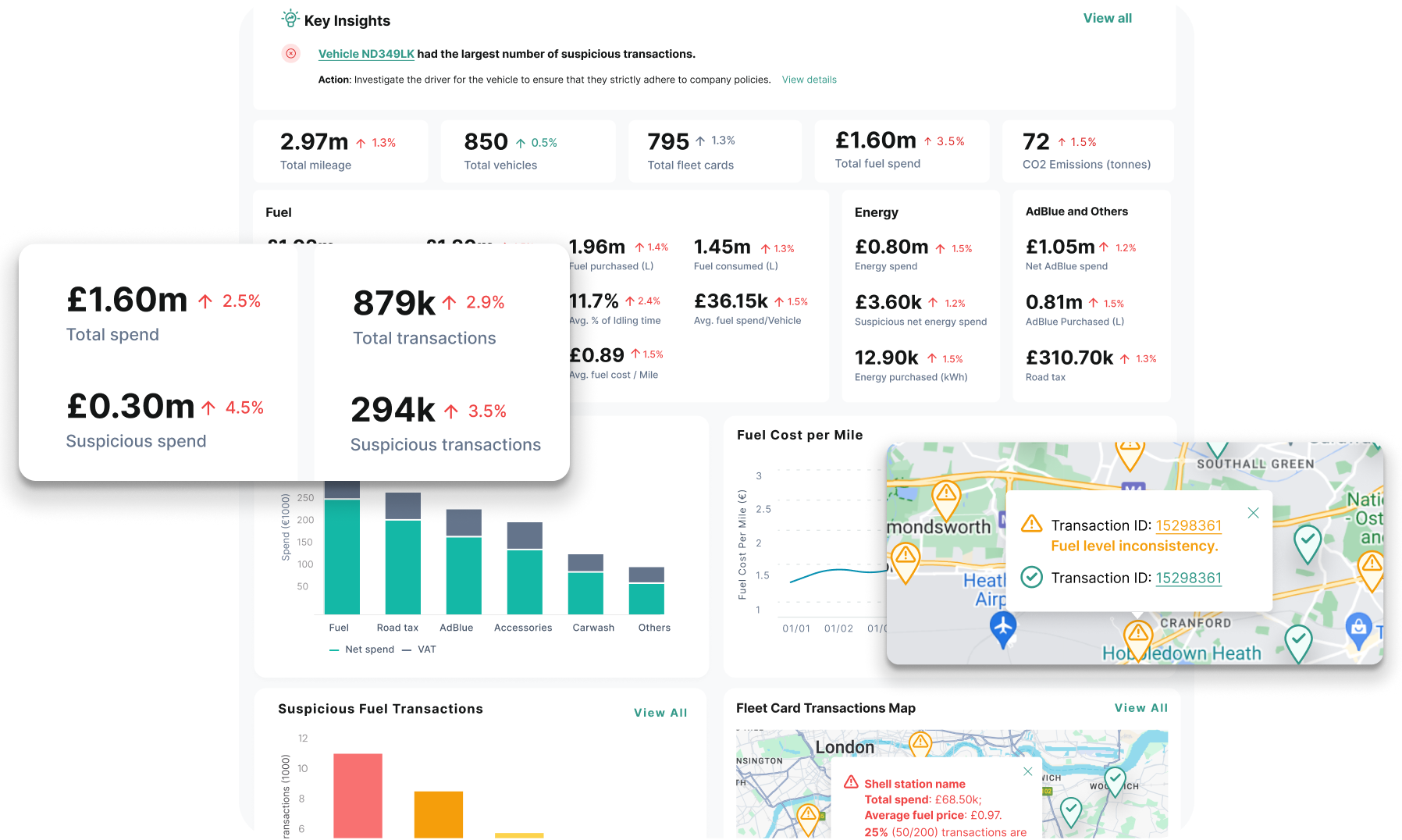
The most powerful feature of modern fuel management is fuel transaction matching. This process uses a fuel card + telematics workflow to verify that the vehicle assigned to a fuel card was actually at the pump when the transaction occurred. By leveraging the Samsara fuel card integration, managers receive fuel fraud detection alerts in real-time.
The matching logic relies on a "Proof Pack" of evidence:
- Time Window: Did the transaction occur while the vehicle was active?
- Geofence Proximity: Was the vehicle within 50 meters of the Shell station coordinates?
- Tank Capacity: Does the transaction volume exceed the physical capacity of the vehicle’s tank?
Common mismatches often stem from card sharing or drivers manually entering the wrong vehicle ID at the pump. Fleevo helps bridge the gap here by automatically flagging these discrepancies in a centralized dashboard, allowing managers to dispute transactions with Shell or address internal policy violations immediately.
Fuel theft and fuel fraud signals to watch first
Fuel theft has evolved beyond simple siphoning. In 2026, fuel card abuse detection is the primary concern. Modern theft detection looks for "impossible locations"—where a card is used twice in two different cities within an hour—and "tank overfills," where a 100-gallon tank is charged for 120 gallons, indicating a secondary container was filled.
Samsara’s fuel level sensors can detect sudden fuel level drops that occur while the ignition is off, which is a clear signal of siphoning. Differentiating between theft, mechanical leaks, and sensor noise requires the high-fidelity data provided by integrating Shell fleet solution telematics with real-time GPS. For a deeper dive into protection, fleets should implement a comprehensive fuel theft prevention checklist.
Reduce idling and stop “invisible burn”
Idling is the "silent killer" of fleet profitability. On average, a heavy-duty truck consumes one gallon of fuel per hour of idling. With the fuel price rising, an extra two hours of daily idling per truck can cost a 50-vehicle fleet upwards of $100,000 annually.
An effective idling reduction fuel savings strategy must be nuanced. You cannot have the same policy for a delivery van in a temperate climate as you do for a reefer unit in the desert.
- Step 1: Establish an idling reduction policy that accounts for vehicle class and climate.
- Step 2: Use Fleevo to identify "Top Idlers" across your entire operation by combining Samsara data with fuel cost impact.
- Step 3: Conduct coaching conversations focused on the "why"—is it for cab comfort, or is it a habit?
Route and dispatch decisions that cut fuel spend fast
Miles eliminated beats MPG improved every single time. Fleet fuel management must involve the dispatch team, not just the drivers. Routing to reduce fuel spend isn't just about the shortest distance; it’s about the "most efficient" distance.
Choosing a route that is five miles longer but maintains a steady highway speed often results in a lower fleet fuel cost per mile than a "shorter" route through a congested city center. To ensure these policies stick, fleets should implement a formal fuel card policy template that includes guidelines on route adherence and preferred fueling stops.
Fuel purchasing strategy during spikes
During price spikes, the where and how of buying fuel are as important as the how much. A robust strategy includes:
- Preferred Stations: Use Shell’s network to lock in corridor pricing and avoid high-margin "last stop" stations.
- Product Restrictions: Ensure cards are locked to "Fuel Only" via your Shell account.
- Centralized Management: Use Fleevo to monitor adherence to these purchasing rules across multiple regions, ensuring drivers aren't deviating to high-cost retail sites unnecessarily.
Maintenance and vehicle health as fuel strategy
A poorly maintained vehicle is a fuel-hungry vehicle. Telematics fuel analytics show that a single "check engine" light related to an oxygen sensor or fuel injector can drop MPG by as much as 20%. Low tire pressure, misaligned axles, and clogged air filters are low-cost fixes that provide immediate fuel savings. By using Samsara to monitor engine fault indicators, maintenance teams can prioritize work orders based on their direct impact on fuel consumption, preventing mechanical issues from ballooning your fuel budget.
Regional variations you must localize
Fuel management is not one-size-fits-all. In the US, fuel taxes vary wildly by state, making automated IFTA reporting a primary use case for Samsara data. In the EU, carbon taxes mean that the "base price" is higher, making idling reduction even more critical. In the APAC region, particularly in markets with less developed infrastructure, fuel theft prevention telematics are often the primary driver for ROI. Tools like Fleevo allow global managers to oversee these regional differences without manually managing hundreds of spreadsheets.
Implementation roadmap
- Days 1–14: Data Plumbing. Connect your Shell Fleet Hub and Samsara account to Fleevo. Ensure all vehicles are correctly VIN-matched and sensors are active.
- Days 15–45: Control & Coaching. Launch your idling policy and set up fuel anomaly alerts. Begin weekly reviews with drivers identified as "high-waste" based on both idling and transaction mismatches.
- Days 46–90: Continuous Improvement. Use gathered data to adjust dispatch routes and renegotiate corridor pricing. Start forecasting fuel spend based on "real-world" efficiency rather than manufacturer estimates.
Conclusion
Fuel price rising cycles will come and go. What stays is the competitive advantage of fleets that treat fuel management as a system: a clean baseline, reliable transaction matching, rapid anomaly detection, and clear governance over how and where fuel is purchased.
If you start with just one change, make it this: define your top five fuel KPIs, assign owners, and review them weekly. Once the team sees a consistent cadence—and sees losses that were previously “invisible”—fuel management stops being reactive and becomes a durable operating habit. For those looking to simplify this transition, platforms like Fleevo provide the necessary automation to turn high-volume fuel data into actionable savings.