
Fuel is one of the largest controllable costs in any commercial fleet — and one of the most exposed to misuse. Research from Shell Fleet Solutions found that fleets lose roughly 2–5% of their annual fuel spend to fraud and misuse, and most of it never shows up as an obvious line on a statement.
So what does fuel card fraud actually look like, and how do you catch it?
What is Fuel Card Fraud?
Fuel card fraud is any use of a company fuel card that doesn't put fuel into a company vehicle for business purposes. It ranges from opportunistic misuse by drivers to organized theft, and it includes:
- Personal fill-ups: Fueling a personal car, a family member's vehicle, or a gas can on the company card
- Card skimming and cloning: Criminals copying card details at compromised terminals and draining the account elsewhere
- Shared-card abuse: One card fueling multiple vehicles, making consumption impossible to attribute
- Phantom fills: Transactions recorded at a station the vehicle never visited
- Product abuse: Premium fuel in a standard vehicle, or non-fuel purchases slipped onto the card
- Fuel theft at the pump: Overfilling into containers alongside the legitimate vehicle fill
The common thread: every one of these looks like a normal transaction on a fuel card statement.
How Much Does Fuel Card Fraud Cost?
Take a 50-vehicle fleet spending $400,000 a year on fuel. At the 2–5% loss rate, that's $8,000–$20,000 leaking out every year — silently, spread across thousands of plausible-looking transactions. For a 200-vehicle fleet, the leak is $32,000–$80,000. Few line items of that size would ever escape a finance team's attention, yet fuel fraud routinely does, because no one can manually review every fill.
How Do You Detect Fuel Card Fraud?
Statement review alone can't catch fraud, because fraudulent transactions are designed to look legitimate. Detection works by cross-referencing every transaction against vehicle data, asking three questions of every fill:
- Was the vehicle there? Match the transaction's station and timestamp against the vehicle's GPS position. A card used 40 miles from its assigned vehicle is the single clearest fraud signal.
- Does the volume fit? Compare gallons purchased against the vehicle's tank capacity and current fuel level. A 35-gallon fill into a 25-gallon tank means fuel went somewhere else.
- Is the product right? Check fuel type against the vehicle. Gas on a diesel vehicle's card — or premium where regular is specified — signals misuse or misfueling.
Beyond the big three, patterns matter: second fills within an hour, weekend transactions on idle vehicles, consumption drifting above what the route mileage supports, and fills that always land just under approval thresholds.
How to Prevent Fuel Card Fraud
- Assign cards to vehicles, not drivers
Vehicle-locked cards with PINs make attribution automatic and sharing harder. - Set product and volume restrictions
Most fuel card providers let you block non-fuel purchases and cap transaction sizes — use them. - Connect cards to telematics
This is the step that changes everything: once every transaction is checked against vehicle location and fuel level automatically, fraud has nowhere to hide. - Audit continuously, not monthly
Fraud caught at month-end has already cost you four weeks. Automated checks flag anomalies as transactions land. - Close the loop with drivers
When drivers know every fill is verified, opportunistic misuse largely stops on its own — the audit is also the deterrent.
#1 AI-powered fleet spend control platform
Ready to Stop Losing Money on Fleet Spend?
See how much you could save in the first week. Start your free trial today. Cancel anytime.
How Fleevo Detects Fuel Card Fraud Automatically
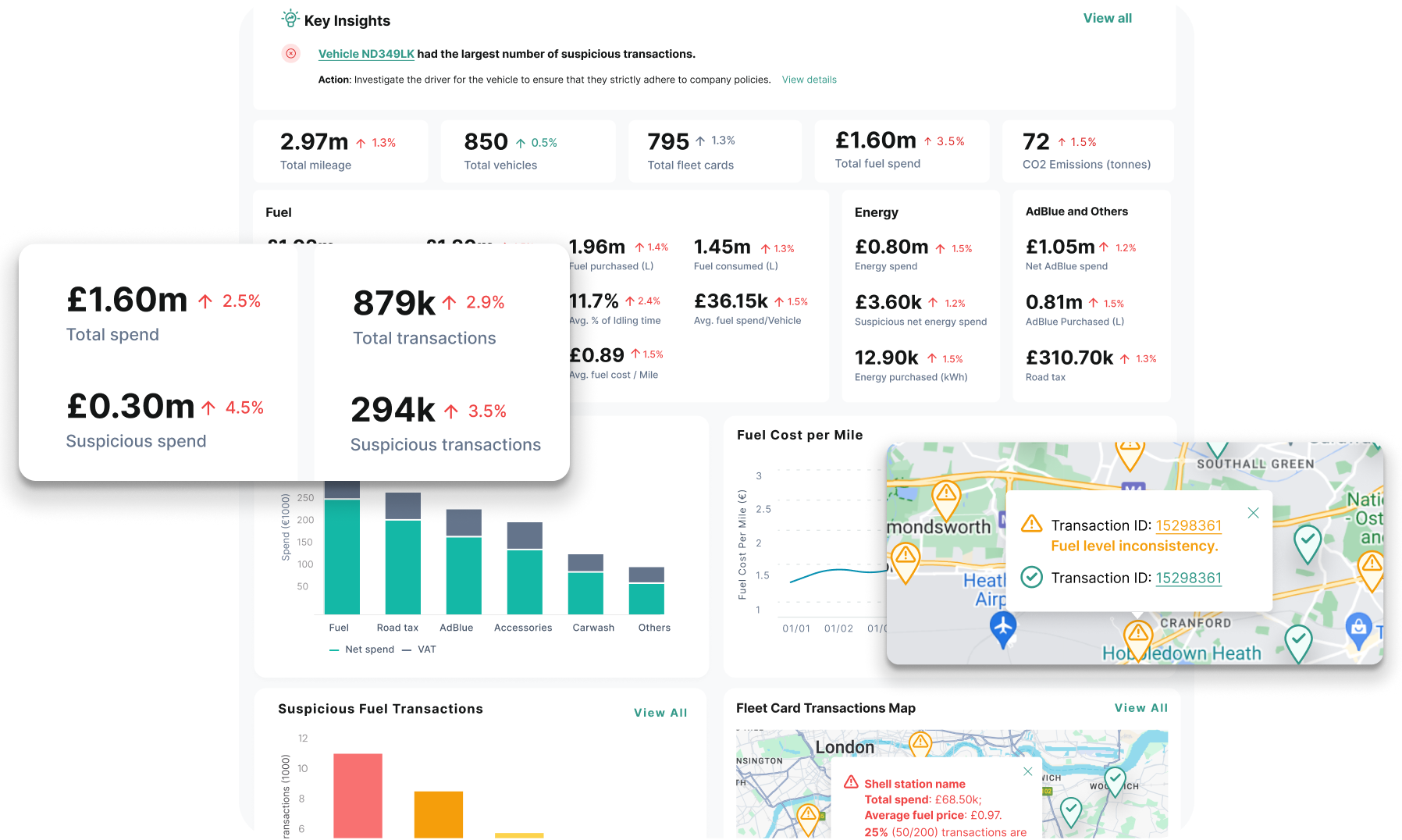
Fleevo connects your fuel cards — WEX, Voyager, and 40+ others — with your telematics, onsite tanks, and vehicle records in one platform. Every transaction is checked automatically against location, tank capacity, fuel level, and fuel type, and anything that doesn't reconcile is flagged for review. You can also describe custom rules in plain English ("flag any second fill within an hour") and Fleevo's AI applies them as live checks. Fleets typically uncover unaccounted fuel activity within their first weeks of connecting.
Fuel Card Fraud FAQs
What is the most common type of fuel card fraud?
Driver misuse — personal fill-ups and overfilling into containers — accounts for most losses in typical fleets. It's small per incident but constant, which is why it compounds into 2–5% of annual fuel spend.
Do PINs stop fuel card fraud?
PINs stop stolen-card abuse by outsiders, but not misuse by the card's legitimate holder — which is where most losses occur. Only transaction-level verification against vehicle data catches that.
Can fuel card fraud be detected without telematics?
Partially. Volume-versus-tank-capacity checks and pattern analysis work from card data alone, but location validation — the strongest signal — requires knowing where the vehicle actually was.
Bottom line: fuel card fraud persists because it hides inside ordinary-looking transactions at a volume no human can review. Automated cross-referencing of every fill against vehicle data turns the fleet's biggest blind spot into its easiest audit.
Explore the platform: Fuel & Energy Management · All Integrations