
You do not need driver ID verification at the pump to detect fuel card fraud. You need the transaction to be checkable against something independent, which in practice means vehicle location, tank capacity, and consumption history. ID verification tells you who presented the card. It does not tell you whether the fuel went into the vehicle it was issued to, which is where most losses actually occur.
That distinction matters, because a card with a PIN and a driver ID prompt can still be used to fill a private vehicle at the next pump along. The control that catches that is not identity. It is corroboration.
The six signals that work without ID
1. Location mismatch. Compare the transaction site coordinates against where telematics places the vehicle at that timestamp. If the vehicle was 30 miles away, the fuel did not go into it. This is the single strongest signal available and it requires no change to the card programme.
2. Volume against tank capacity. A transaction that dispenses more litres than the vehicle's tank can physically hold means fuel went somewhere else, most often into a second container. Set the threshold at tank capacity plus a small tolerance rather than at an arbitrary round number.
3. Consumption implausibility. Litres purchased against distance covered since the previous fill gives an implied consumption figure. When that figure drifts well outside the vehicle's own established range, either fuel is leaving the vehicle or odometer data is wrong. Both need investigating.
4. Split and sequential transactions. Two or more transactions at the same site within a short window, or a legitimate fill immediately followed by a small second transaction, is a common pattern for adding fuel that is not going into the vehicle. Single transaction limits do not catch it. Time-windowed aggregation does.
5. Product mismatch. Petrol on a diesel vehicle, or AdBlue on a vehicle with no AdBlue system. This one is trivially detectable and is usually a straight indicator that the card was used on another vehicle.
6. Time and day pattern breaks. Transactions outside operating hours, on days the vehicle shows no activity, or during periods the vehicle was recorded as off road. A fill on a vehicle that was in the workshop is unambiguous.
Why single signals produce false positives
Each signal alone generates noise. Telematics units drop out. Odometer prompts get mistyped. A driver legitimately fills a spare bowser. A vehicle genuinely goes out of area.
The reliable approach is to require corroboration across at least two independent signals before a case is raised, and to weight by how hard each signal is to explain away. A location mismatch plus a volume exceeding tank capacity is close to conclusive. An unusual consumption figure on its own is usually a data problem.
This is also why threshold rules alone underperform. A fixed litre cap flags every large legitimate fill and misses every small illegitimate one. Comparing each vehicle to its own history, and each transaction to its own context, is what separates signal from noise.
What to do when you cannot get telematics coverage
Not every vehicle has a telematics unit, and grey fleet and hired vehicles rarely do. On those you still have four of the six signals: volume against known tank capacity, implied consumption from odometer prompts, split transaction patterns, and product mismatch. That is a materially weaker net, but it is far from nothing, and it is much better than statement review.
Where a vehicle has neither telematics nor reliable odometer capture, accept that transaction level detection is not available and manage it through tighter card controls instead: product locks, volume caps, and site restrictions.
#1 AI-powered fleet spend control platform
Ready to Stop Losing Money on Fleet Spend?
See how much you could save in the first week. Start your free trial today. Cancel anytime.
Running These Checks In Fleevo
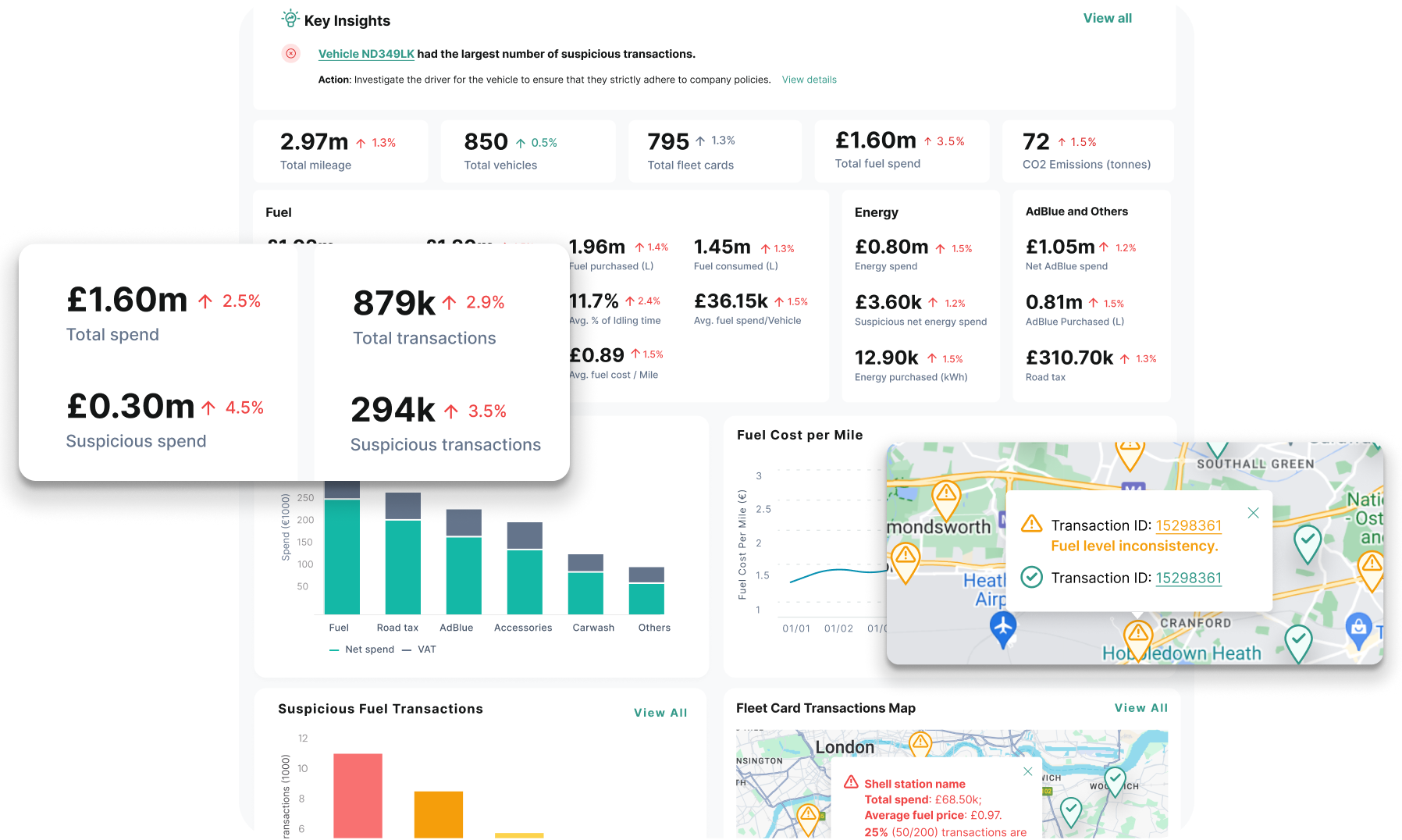
Fleevo joins fuel card transactions, onsite tank dispensing records and charge point sessions to telematics position and odometer data, then runs both deterministic checks and per vehicle anomaly detection across every transaction. Cases arrive with the corroborating evidence attached, which is what makes them usable in a conversation with a driver or a supplier rather than just a list of suspicions. To see what these checks surface in your own data, contact Fleevo or book a demo. See also fuel and EV charge management, the fuel fraud patterns we see most often, and how to compare fraud detection software.
Fuel Card Fraud Detection FAQs
Can you detect fuel card fraud without identity verification?
Yes. Location matching against telematics, volume against tank capacity, implied consumption, split transaction detection, product mismatch, and time pattern breaks all work from transaction and vehicle data alone, with no driver identification involved.
Does driver ID verification at the pump stop fuel card misuse?
It reduces card sharing and use of lost or stolen cards. It does not stop a legitimate cardholder putting fuel into a vehicle that is not theirs, which is the more common and more expensive pattern.
What is the strongest single indicator of fuel card misuse?
A transaction location that does not match the vehicle's telematics position at that timestamp. It is difficult to explain innocently and does not depend on driver behaviour or self reported data.
How do you detect split fuel transactions?
Aggregate transactions by card and site within a rolling time window rather than assessing each transaction in isolation. Two fills 90 seconds apart look normal individually and obvious once combined.
Can AI detect unauthorised fuel spend?
Anomaly detection is useful for the part of the problem that rules handle badly: learning each vehicle's own normal consumption, timing and site pattern, then flagging deviation. It works best as a layer on top of deterministic checks like tank capacity and location matching, not instead of them.
What if some vehicles have no telematics?
Four of the six signals still apply: volume against tank capacity, implied consumption from odometer prompts, split transaction patterns, and product mismatch. Compensate with tighter card controls on those vehicles.