
After looking at fuel card activity across a lot of different fleets, one thing stands out: the fraud that actually costs fleets money is rarely sophisticated. There's no elaborate scheme. It's the same small set of patterns, repeated quietly, month after month, hiding inside statements that everyone assumes are fine because the totals look roughly normal.
What follows isn't a list of edge cases. These are the patterns that come up again and again, in fleets of every size and across every fuel card provider. None of them is exotic. That's exactly why they work.
1. One Card, Many Drivers
The most common pattern isn't theft at all, at least not to start with. It's fuel card sharing: a card assigned to one vehicle or driver ends up being used by several. A spare card lives in the depot for whoever needs it. An agency driver borrows a colleague's. A card gets left in the glovebox rather than issued to a named person.
Almost always, it starts as a practical workaround, not an attempt to cheat. But it quietly dismantles the one assumption every fuel card system depends on: one card, one vehicle, one driver. Once that link breaks, every other check becomes negotiable. An unusual purchase can always be explained away with "someone else must have used the card", and there's no way to prove otherwise. Card sharing rarely shows up as fraud on a report. It shows up as the reason real fraud is impossible to pin down.
2. The Fuel That Never Reached the Tank
The second pattern is more deliberate: fuel is paid for, but not all of it goes into the fleet vehicle. The transaction looks legitimate, the volume looks plausible, and the money leaves the account, but some or all of the fuel ends up somewhere else.
In practice this takes a few forms. A driver fills the fleet vehicle and a personal car on the same visit. A jerry can gets topped up alongside the tank. Occasionally the fuel is sold on entirely. The tell is almost always in the numbers rather than the receipt: a fill that exceeds the vehicle's tank capacity, two full fills within a day or two, or a steady, unexplained drop in miles-per-gallon against the vehicle's own history. Each figure on its own is easy to dismiss. Seen together, and compared against what the vehicle can actually hold and how far it actually travelled, they tell a different story.
3. The Vehicle That Wasn't There
The third pattern is the hardest to explain away, and for that reason it's the most valuable signal a fleet has. Fuel is purchased at a station the vehicle simply wasn't near. The card was present; the vehicle wasn't.
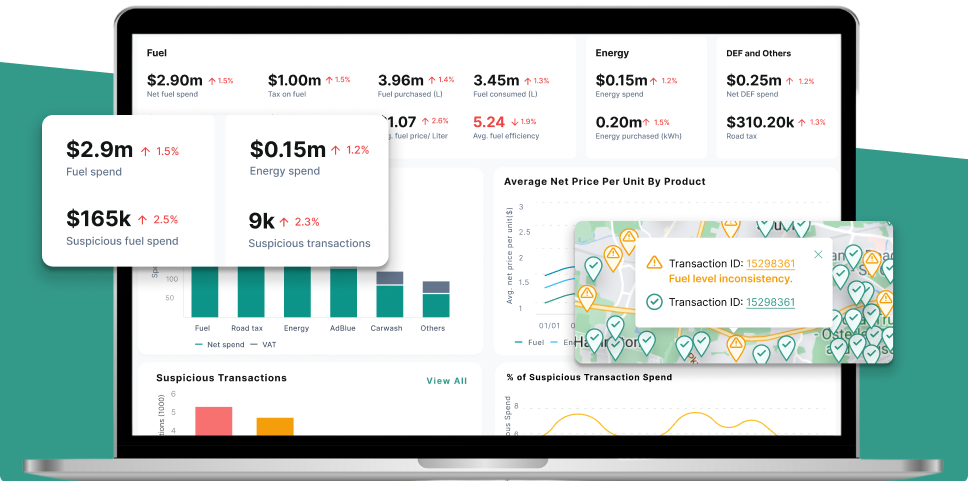
Volume and timing anomalies can usually be argued down: maybe the tank was closer to empty than expected, maybe two trips got combined. A location mismatch is different. When telematics places a vehicle thirty miles away at the moment its card was used at a pump, there's no innocent version of the numbers that fits. This is where card sharing and fuel diversion often become visible for the first time, not because the purchase itself looks odd, but because it happened somewhere the vehicle physically couldn't have been.
Six More Patterns Worth Checking
Those three account for most of what we see, but a handful of others turn up often enough to be worth a specific check. Each leaves a different signature, which means each needs a different test.
- Split transactions. Two or more purchases at the same site within minutes, each kept below whatever single-transaction limit exists. Per-transaction limits are structurally blind to this. Catching it means aggregating by card and site over a rolling time window.
- Odometer padding. Readings entered at the pump that overstate distance, so implied consumption looks normal when it isn't. Compare the driver-entered figure against the telematics odometer. Occasional typos are noise; persistent divergence in one direction is not.
- Unattributed draw from onsite tanks. Tank dispensing totals that exceed the sum of fills attributed to vehicles, with the shortfall sitting in an unexplained variance line. Reconcile deliveries, dip readings, and dispensed volume against attributed vehicle draws. Onsite tanks are the least monitored fuel source in most fleets and often the largest single leak.
- Siphoning from the vehicle. A sharp drop in telematics fuel level while the engine is off and the vehicle is stationary, unmatched by any consumption. Engine state is the qualifier that makes this conclusive: a drop while driving is consumption, a drop while parked is not.
- Personal EV charging on the fleet account. A charge session delivering more kWh than the vehicle's usable battery can hold, or running at a location the vehicle wasn't at. The direct analogue of the tank capacity check, and a pattern growing quickly as fleets electrify.
- Site-level irregularities. Volumes consistently rounded up, or charges for fuel never dispensed, concentrated at one location. This one is invisible per vehicle and only appears when you compare implied consumption for the same vehicles across different sites. If one site consistently produces worse figures, the site is the variable.
If you can only implement two checks, make them location matching and volume against tank capacity. Between them they cover patterns 1, 2, 3, and the EV variant, which is where most of the money sits. Onsite tank reconciliation is the highest-value check that most fleets have never run at all.
Why These Patterns Survive
None of these patterns is clever. They persist because of how fuel spend is usually reviewed: once a month, after the fact, as a single consolidated total. At that level everything nets out to something believable. The shared card, the extra ten litres, the fill in the wrong town, all of it disappears into an aggregate that looks fine.
They also survive because catching them means joining up data that normally lives apart: the fuel transaction, the vehicle it belongs to, that vehicle's tank size and fuel type, and where it actually was at the time. Any one of those in isolation proves nothing. It's the combination that turns an ordinary-looking line item into a question worth asking, and that combination is exactly what a monthly spreadsheet can't see.
#1 AI-powered fleet spend control platform
Ready to Stop Losing Money on Fleet Spend?
See how much you could save in the first week. Start your free trial today. Cancel anytime.
How Fleevo Surfaces These Patterns
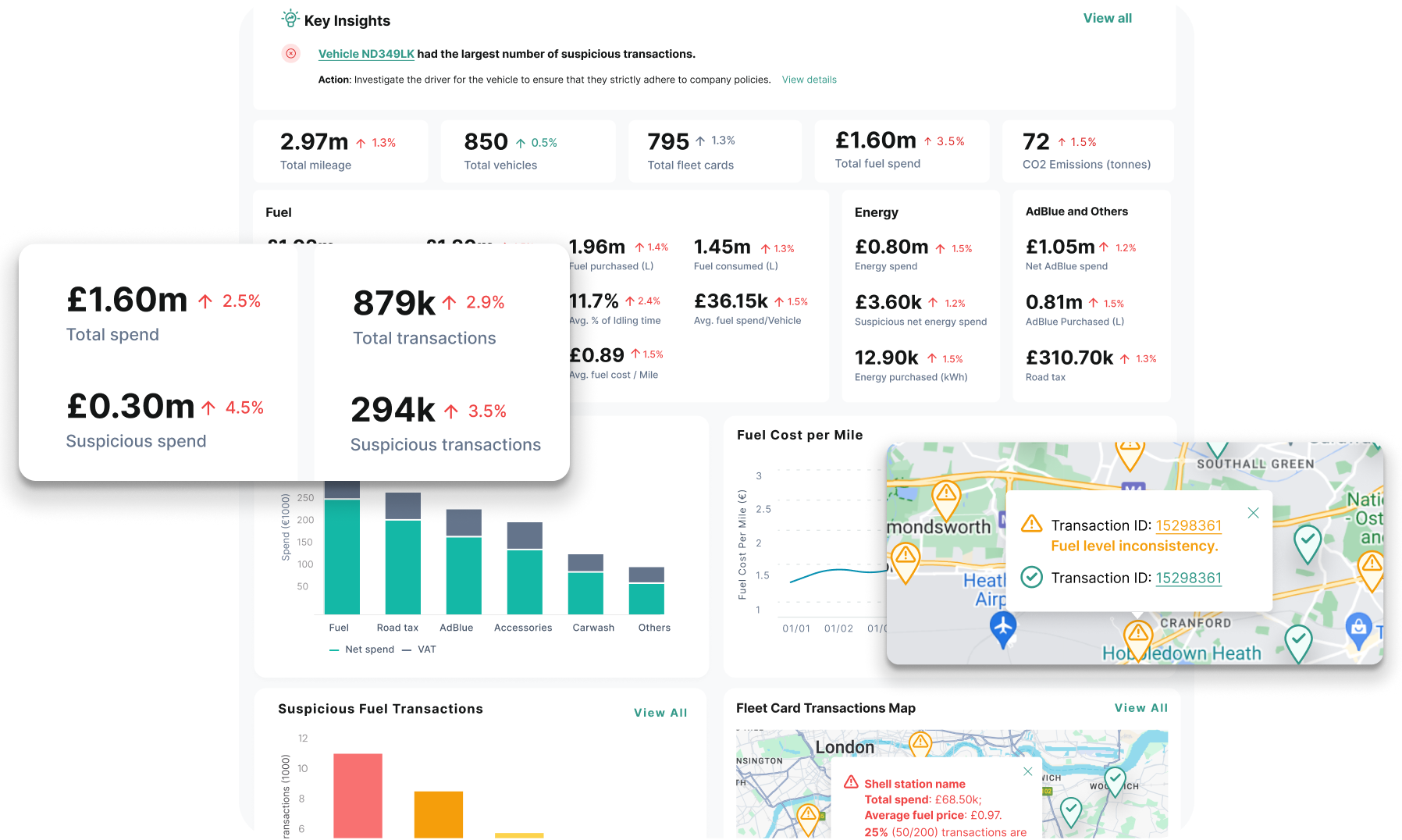
Fleevo works by joining up the data these patterns rely on staying separate. Every fuel transaction is matched to the vehicle it's assigned to and checked against that vehicle's fuel type, tank capacity, and, where telematics is connected, its actual location and odometer at the time of purchase. A card fuelling a vehicle it isn't assigned to, a volume that can't fit in the tank, or a purchase somewhere the vehicle wasn't gets flagged as it happens, instead of disappearing into a monthly statement. Explore Fuel & EV Charge Management, read what fuel card fraud is, or work through the monthly fuel card audit checklist.
Fleet Fuel Fraud FAQs
What is the most common type of fleet fuel fraud?
Fuel card sharing, more than one driver or vehicle using the same card, is the most common by far. It's usually not malicious, but it breaks the link between card and vehicle that every other fraud check depends on, which makes genuine fraud far harder to detect.
How can you tell if fuel isn't reaching the vehicle?
Compare purchased volume to the vehicle's tank capacity, watch for multiple full fills in a short window, and track miles-per-gallon against the vehicle's own history. A single anomaly means little; a pattern of them, measured against what the vehicle can actually hold and how far it travelled, is the signal.
What's the strongest evidence of fuel fraud?
A location mismatch. When a card is used at a station the vehicle's telematics shows it wasn't near, there's no innocent explanation that fits the data, unlike volume or timing anomalies, which can usually be argued away.
How do you detect split fuel transactions?
Aggregate transactions by card and site within a rolling time window rather than assessing each one in isolation. Two fills ninety seconds apart look unremarkable individually and obvious once combined.
Can fuel be stolen from the vehicle itself?
Yes, and telematics fuel level makes it detectable: a sharp drop while the engine is off and the vehicle is stationary, with no corresponding consumption. Engine state is what separates siphoning from normal use.
How do you prove fuel card fraud?
With corroborating records rather than a single anomaly: the transaction, the vehicle's position and engine state at that timestamp, the tank capacity, and the consumption history either side of the event. Two independent signals that agree is the practical standard, and it is worth verifying before anyone raises it with a driver.
Why doesn't a monthly fuel report catch this?
Because it aggregates. At the level of a single monthly total, shared cards, small diversions, and out-of-place fills all net out to a believable number. Catching them requires checking each transaction against the specific vehicle, its specs, and its location, continuously rather than once a month.