
A fuel card statement lists what was charged. It does not tell you whether each transaction was legitimate, matched a real vehicle, or made sense for the miles driven. Fleet fuel reconciliation is the step that answers those questions, by matching every fill against your own data. Here is what it involves and how to do it at scale.
What Is Fleet Fuel Reconciliation?
Fleet fuel reconciliation is the process of checking each fuel card transaction against the vehicle, driver, mileage, and tank data behind it, so that what you were billed matches what actually happened. Instead of paying a statement on trust, you confirm every line, or flag the ones that do not add up.
What Reconciliation Checks For
- Location mismatch: a fill where the vehicle was not near the station.
- Volume over tank size: more fuel than the vehicle could hold.
- Wrong fuel type: a grade the vehicle does not take.
- Duplicate or double charges: the same transaction billed twice.
- Consumption drift: fuel economy that has quietly worsened.
Why the Two Datasets Do Not Line Up
Before the mechanics, it helps to understand why this is difficult at all. Fuel card data and telematics data were never designed to share a key, so every reconciliation is a reconstruction rather than a lookup.
- Different identifiers. The statement identifies a card and a site. Telematics identifies a device and a set of coordinates. The vehicle registration, the only natural key between them, appears reliably in neither.
- Different time bases. Card transactions are timestamped at authorisation, sometimes with a settlement delay and sometimes in a different time zone. Telematics is continuous and usually in UTC.
- Different granularity. A transaction is one event. Telematics is a stream, so matching means finding the nearest position to a timestamp rather than reading a field.
- Location precision. The statement gives a site name and often a partial address; telematics gives coordinates. Matching a forecourt name to a coordinate is a geocoding problem with a real error rate.
- Coverage gaps. Not every vehicle has telematics, not every card maps to a current vehicle, and onsite tanks frequently have no digital record at all.
The Five Joins That Make It Work
- Card to vehicle, with history. The mapping has to be time-aware. A card reassigned in March means transactions before and after belong to different vehicles, and a current-state mapping silently attributes the whole year to the wrong asset. This is the join most reconciliations get wrong.
- Telematics device to vehicle, with history. The same problem. Units get swapped between vehicles, so the mapping needs effective date ranges.
- Site to coordinates. Build a reference of the fuel sites your fleet actually uses, geocoded once, rather than geocoding a text address on every transaction. That set is finite and fairly stable.
- Transaction timestamp to vehicle position. Find the vehicle's position within a tolerance window around the authorisation time, accounting for time zone and settlement delay. A few minutes is normal, and the tolerance should be a documented parameter rather than an assumption buried in a formula.
- Consumption between fills. Litres or gallons purchased against distance covered since the previous fill, giving implied consumption per vehicle. This is what makes the reconciliation useful rather than merely complete.
Handling What Will Not Match
Some proportion never matches, and pretending otherwise is what makes a reconciliation untrustworthy. Categorise the residual rather than absorbing it:
- No telematics on the vehicle. Not a discrepancy, just an absence of corroboration. Report it separately.
- Telematics dropout at the transaction time. Signal loss, unit fault, or an underground site. Genuinely ambiguous.
- Card not mapped to any vehicle. A data maintenance failure, and entirely within your control to fix.
- Site not geocoded. A new site. Add it to the reference.
- Matched but implausible. Location or volume genuinely inconsistent with the vehicle. This is the category that matters, and separating it from the four above is the whole point.
Report the match rate every month. A reconciliation that quietly matches 60% of transactions and presents a clean total is worse than no reconciliation, because it manufactures false confidence.
Why Manual Reconciliation Falls Down
Done by hand, reconciliation means exporting the fuel statement, pulling mileage from telematics, and matching them line by line in a spreadsheet, every month, across every vehicle. It is slow, it happens after the money is already spent, and the volume means most discrepancies are never caught. That is exactly where fuel fraud and waste survive.
The deeper reason spreadsheets fail is the first two joins above. Card-to-vehicle and device-to-vehicle relationships change, and historical accuracy depends on tracking those changes with effective dates. That is the part a monthly spreadsheet cannot carry.
How to Reconcile Fuel at Scale
- Bring the data together. Fuel card transactions, telematics, and tank data in one place.
- Match each transaction. Tie every fill to a vehicle and to where it was at the time.
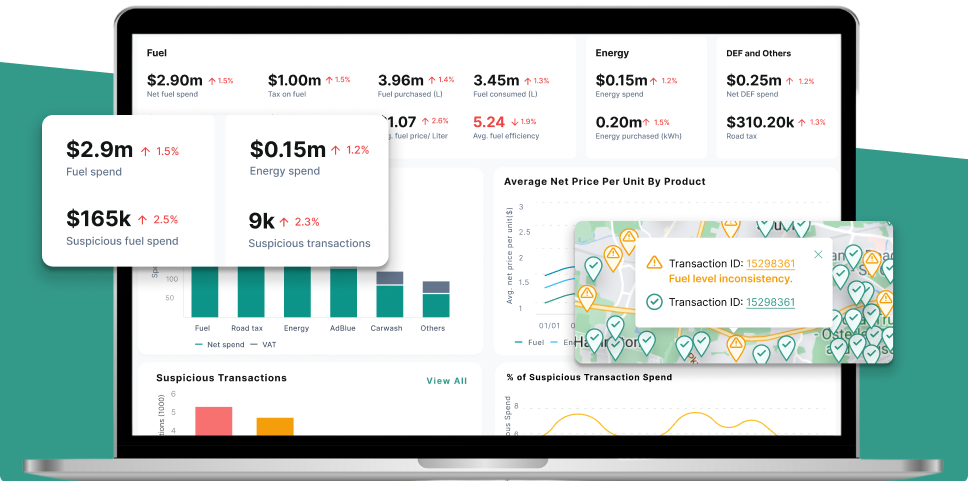
- Apply checks automatically. Flag location, volume, fuel-type, and duplicate issues.
- Review only the exceptions. Investigate the flagged transactions, not all of them.
What Good Looks Like
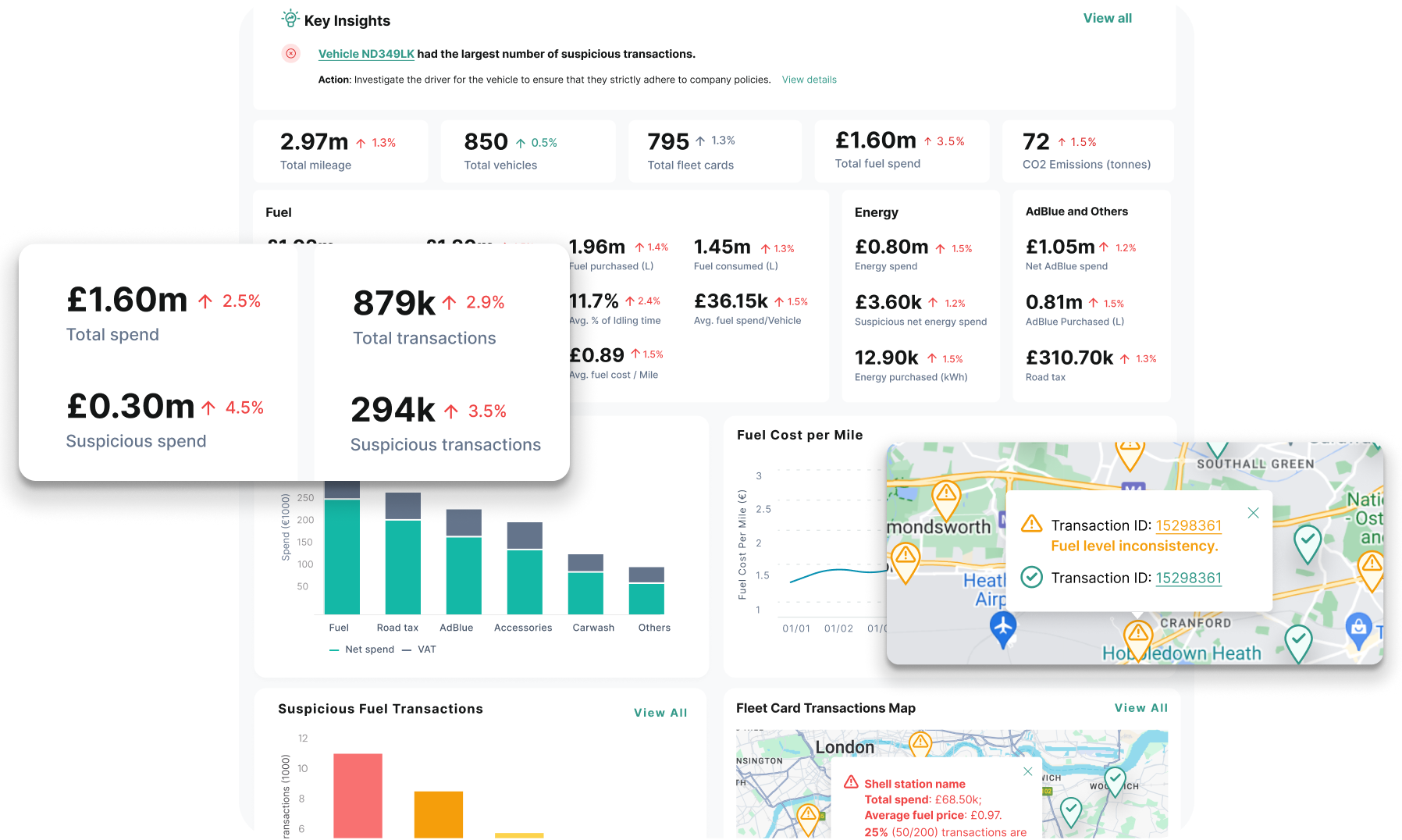
A monthly position stating four numbers rather than one: total volume purchased, volume corroborated against vehicle activity, volume uncorroborated with the reason, and volume flagged as implausible with the supporting evidence. That is the report finance can rely on and the fleet team can act on.
#1 AI-powered fleet spend control platform
Ready to Stop Losing Money on Fleet Spend?
See how much you could save in the first week. Start your free trial today. Cancel anytime.
How Fleevo Automates Fuel Reconciliation
Fleevo matches every fuel card transaction against telematics and tank data automatically, so reconciliation happens continuously instead of once a month. It maintains the time-aware card and device mappings, a geocoded site reference, and per-vehicle consumption baselines that the matching depends on. Genuine discrepancies, such as location mismatches, over-tank volumes, wrong fuel, and duplicates, are flagged for review, and the clean data feeds cost per vehicle and audit-ready reporting. See how it fits fuel card integration and fleet invoice management, or explore Fuel and Energy Management.
Fleet Fuel Reconciliation FAQs
What is fuel reconciliation?
Checking each fuel card transaction against the vehicle, mileage, and tank data behind it, so billed fuel matches actual usage and anything suspicious is flagged.
How do you reconcile fuel card statements?
By matching each transaction to a vehicle and its location and mileage at the time, then flagging fills that do not fit. Software automates the matching so it does not have to be done line by line.
Why is it so hard to reconcile fuel spend against telematics?
The two datasets share no common identifier, use different time bases and granularity, and describe location in incompatible ways. Reconciliation means reconstructing the link through card-to-vehicle mappings, site geocoding, and timestamp matching, and all three need maintaining as vehicles and cards change.
Why do fuel card volume and telematics consumption differ?
Legitimately, because of tank level at the time of the fill, fuel level sensor tolerance, and timing differences. Illegitimately, because fuel left the vehicle. Establishing the normal variance range per vehicle is what lets you tell the two apart.
What match rate should you expect?
It depends almost entirely on telematics coverage and mapping hygiene. What matters is not the absolute rate but that it is measured, improving, and that the unmatched remainder is categorised rather than ignored.
Why is fuel reconciliation important?
It catches fraud, misuse, billing errors, and waste that a paid-on-trust statement hides, and it produces the clean fuel data that cost-per-vehicle and TCO depend on.
Explore the platform: Fuel and Energy Management.