
Getting a fuel card is easy. Getting the most out of it — lowest real cost, zero misuse, every gallon accounted for — is where most fleets leave money on the table. A fuel card optimizer is the layer that turns raw card data into actual savings. Here's what optimizing fuel cards involves and how to do it.
What is a Fuel Card Optimizer?
A fuel card optimizer is software that analyzes your fuel card transactions to reduce total fuel cost — not by switching cards, but by getting more control over how the cards you have are used. It cross-references every transaction against vehicle data to catch misuse, benchmarks what you're actually paying, flags inefficiency, and removes the manual admin of reconciling statements. The card gives you a network and a price; the optimizer makes sure you're not overpaying or being defrauded on either.
How to Optimize Your Fuel Cards
- Catch misuse and fraud
Fleets lose 2–5% of fuel spend to misuse and fraud. Cross-reference every fill against the vehicle's location, tank capacity, and fuel type to flag personal fill-ups, shared-card abuse, and overfills automatically. - Benchmark what you actually pay
Pump prices vary widely across a network. Analyzing where and when drivers fill — and steering them toward better-value sites on their routes — cuts cost without changing cards. - Reconcile against real mileage
Tie fuel spend to telematics mileage to spot vehicles consuming more than their routes justify — the early signal of idling, driving style, or a mechanical fault. - Eliminate manual admin
Automated data collection removes the month-end scramble of exporting statements and matching spreadsheets — hours back, and fewer errors. - Unify multiple cards
If you run more than one card, a single optimized view across all of them is the only way to see total fuel spend and compare performance.
Optimizing a Fuel Card vs Switching Fuel Cards
These are different moves. Choosing the right card gets you the right network and pricing model for your fleet. Optimizing is what you do afterwards — continuously — to make sure that card delivers its full value and isn't quietly leaking spend. Switching cards without an optimizer just moves the same blind spots to a new provider.
#1 AI-powered fleet spend control platform
Ready to Stop Losing Money on Fleet Spend?
See how much you could save in the first week. Start your free trial today. Cancel anytime.
How Fleevo Optimizes Your Fuel Cards
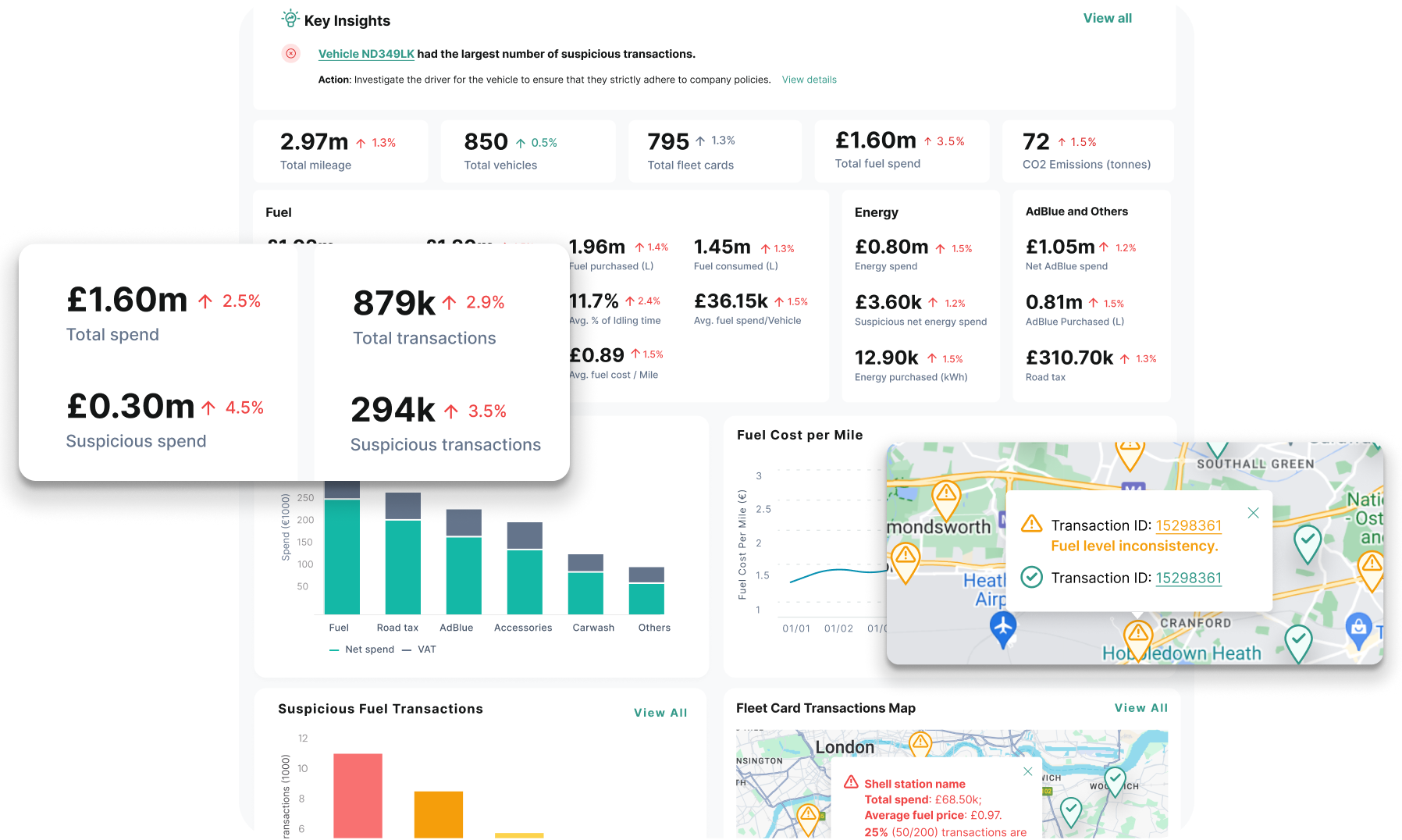
Fleevo works with 40+ fuel cards — Shell, WEX, Voyager, BP, Allstar, and more — as an optimization layer on top of whatever cards you carry. It automatically collects every transaction, checks it against vehicle location, tank capacity, fuel level, and fuel type, benchmarks spend, and reconciles fuel against mileage — all continuously, across every card in one view. You can add custom checks in plain English, and switching or adding a card never fragments your data. Fleets typically uncover unaccounted fuel activity within their first weeks. See how Egertons Recovery strengthened fuel oversight with Fleevo.
Fuel Card Optimizer FAQs
What does a fuel card optimizer do?
It analyzes fuel card transactions to reduce total fuel cost — catching misuse and fraud, benchmarking pricing, reconciling spend against mileage, and removing manual reconciliation, all without switching cards.
Can I optimize more than one fuel card at once?
Yes. A good optimizer consolidates every card into one view, which is the only practical way to see total fuel spend and compare performance across providers.
Do I need to change fuel cards to save money?
Usually not. Most savings come from controlling how existing cards are used — eliminating misuse, waste, and admin — rather than from switching provider.
Bottom line: the card is only half the equation. A fuel card optimizer makes sure you're not overpaying or being defrauded — catching misuse, benchmarking spend, and reconciling every gallon against the vehicle, continuously and across every card you run.
Explore the platform: Fuel & Energy Management · All Integrations