

Grey fleet mileage is usually the largest block of self-reported, unverified spend in an organisation. Claims arrive as a total, get approved by a manager with no independent reference, and are paid. There is no equivalent of a fuel card statement to check them against.
The exposure is not primarily fraud. It is rounding, estimation, and the inclusion of journeys that were not business. At volume that compounds into a real number, and it is also the evidence base a tax authority will ask for.
What a defensible mileage record contains
For each business journey: date, start point, end point, business purpose, and distance. Postcode to postcode is the practical standard for start and end. A monthly total with no journey detail is not a record, and it will not survive a tax enquiry.
Note that business purpose is the field most often omitted and the one that determines whether a journey qualifies at all.
Four ways to verify
1. Route distance calculation. Recalculate each claimed journey from postcode to postcode and compare to the claim. This is automatable and catches the bulk of over-claiming. Allow a sensible tolerance for genuine diversions rather than querying every small difference.
2. Pattern analysis across claimants. Compare the same journey claimed by different people, and the same journey claimed repeatedly by one person. Persistent divergence from the route distance in one direction is the signal, not any single claim.
3. Cross reference against calendar or job records. A journey to a customer site on a day with no appointment or job for that customer is worth a question. This is the check that finds non-business journeys, which route distance validation cannot.
4. Voluntary telematics or a mileage capture app. The most accurate option and the most sensitive, since it means recording an employee's movements in their own vehicle. If you go this route, make it trip-based rather than continuous tracking, be explicit about what is captured and what is not, and give drivers a clear reason it benefits them, which is usually that accurate capture means they stop under-claiming.
Auditing historic mileage
If you need to reconstruct a defensible position for past periods, work backwards in this order:
- Pull all claims for the period with whatever journey detail exists
- Recalculate route distances for every journey that has usable start and end points
- Quantify the claims that cannot be recalculated because detail is missing, and report that as a data quality finding rather than trying to estimate it
- For the recalculable set, report the aggregate variance between claimed and calculated distance
- Fix the claim form so the missing fields cannot be omitted in future
That last step matters more than the audit itself. Most historic mileage problems are form design problems: if the form accepts a bare total, people will submit a bare total.
Reimbursement rate as a separate question
Verification tells you the distance was real. It says nothing about whether the rate is right. Those are separate reviews and worth keeping separate, because conflating them turns a straightforward data exercise into a negotiation about pay.
#1 AI-powered fleet spend control platform
Ready to Stop Losing Money on Fleet Spend?
See how much you could save in the first week. Start your free trial today. Cancel anytime.
Grey Fleet Mileage In Fleevo
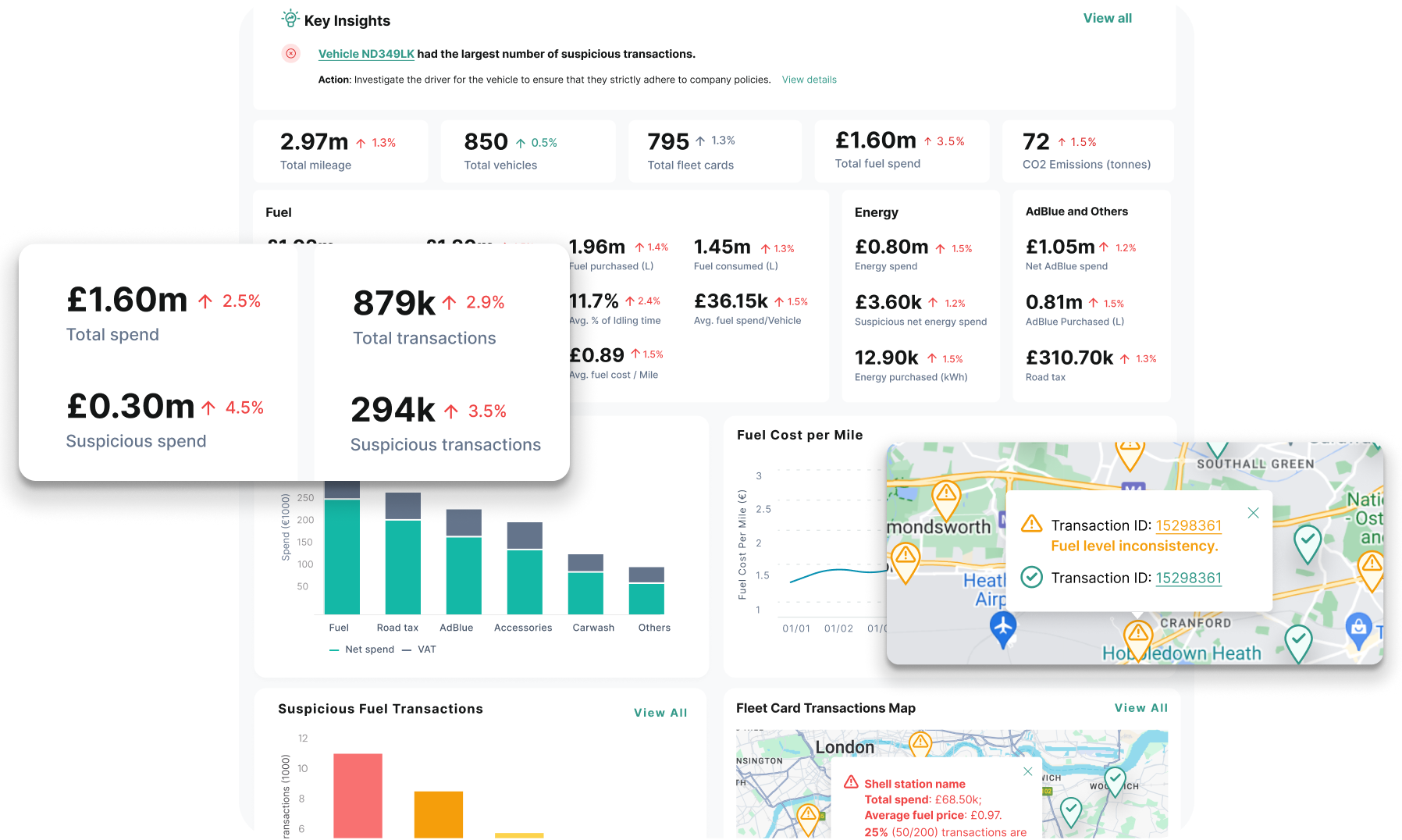
Fleevo holds mileage alongside fuel, charging and maintenance cost per vehicle, including grey fleet, so claimed distance can be tested against route distance and against any fuel or charging spend on the same vehicle. Where a vehicle has both a card and a mileage claim, the overlap shows up immediately. To test your own mileage claims against route distance, contact Fleevo or book a demo. For the wider picture, start with our overview of grey fleet management, then see the grey fleet audit checklist, grey fleet risks, and grey fleet policy.
Grey Fleet Mileage FAQs
How can I audit fleet mileage?
Recalculate claimed journeys from start and end postcodes, compare against the claim with a reasonable tolerance, and analyse patterns per claimant and per route. For owned vehicles with telematics, compare claimed business mileage against total recorded distance.
What mileage records does a tax authority expect?
Journey level records with date, start and end points, business purpose and distance. Monthly totals without journey detail are generally not sufficient evidence.
Can I require grey fleet drivers to install tracking?
It is a personal vehicle, so this needs care: a clear lawful basis, transparency about exactly what is captured, and ideally trip-based capture the driver initiates rather than continuous location tracking. Voluntary adoption with a genuine benefit to the driver works better than mandation.
How much over-claiming is typical?
It varies too much by organisation and claim process to generalise, and any figure quoted without reference to your own data is not worth acting on. Run the route recalculation on 12 months of your own claims and you will have the real number in an afternoon.
Should mileage claims and fuel card use ever overlap?
No. A driver with a fuel card should not also claim per mile for the same journeys. This double payment is a specific thing to test for where both mechanisms exist in the same organisation.