
Diesel exhaust fluid (DEF) is a small line on the fuel bill, which is exactly why few fleets check it. A truck burning 20,000 gallons of diesel a year uses about 400 gallons of DEF, and at truck stop prices of around $4.30 to $4.60 a gallon, that is well over $1,500 per truck. Across a fleet, DEF is a five or six-figure spend bought on fuel cards, from jugs, and from onsite totes, often with no one comparing it to what the vehicles actually used.
This guide covers how much DEF your fleet should use, where DEF money leaks, and how to control it.
How much DEF should a truck use?
DEF use tracks diesel use. The Maryland Department of the Environment puts it at about 2% of diesel consumed for on-road trucks, a ratio of roughly 50 to 1. Cummins puts some engines, including off-highway Tier 4 Final equipment, at 3% to 5%.
That ratio is the most useful number in DEF management. For each vehicle:
Expected DEF = diesel gallons × that engine's DEF rate
A truck that bought 1,000 gallons of diesel last quarter should have bought around 20 gallons of DEF (or 30 to 50 for a higher-dosing engine). If it bought 60, something is wrong. If it bought none, it was either filled from a tote nobody recorded, or it is running without DEF.
Where DEF money leaks
Buying at the most expensive point
DEF bought in 2.5-gallon jugs at retail costs far more per gallon than DEF from the pump at a truck stop, and pump DEF costs more than bulk delivered to your yard. Drivers grabbing jugs because it is convenient adds up quickly across a fleet. A fuel card report split by purchase type shows how much of your DEF is bought the expensive way.
Purchases that never reach the vehicle
DEF is easy to carry away. A jug bought on the company card can go into a personal pickup, a farm truck, or a resale. Unlike diesel, DEF purchases rarely get a second look on a fuel card statement. There is little published data on how common DEF misuse is, but the pattern is the same as any side-fueling: a purchase that does not match the vehicle it was billed to.
DEF bought for vehicles that do not use it
Gasoline vehicles, older pre-SCR diesels, and light vehicles on the same card program should never buy DEF. A DEF transaction against one of them is either a miscoded card or misuse.
Spoiled DEF
DEF degrades with heat. Per the shelf-life table Ford Motorcraft publishes (based on ISO 22241-3), DEF lasts about 36 months stored at or below 50°F, 12 months at up to 86°F, and only 2 months near 104°F. Totes left in a hot yard all summer can go off-spec, which risks SCR faults and wasted product. DEF also freezes below 12°F.
Downtime when a truck runs out
Running out of DEF or using bad DEF triggers warnings and, eventually, engine derates. EPA has revised its guidance on how quickly and severely trucks derate several times in 2025 and 2026, and has proposed going further, so check the current rules for your model years. Whatever the schedule, a truck limping to a shop is far more expensive than the fluid that would have prevented it.
How to control DEF spend
- Track DEF per vehicle, next to diesel. DEF on its own is a list of purchases. DEF divided by diesel, per vehicle, is a control.
- Set an expected range per engine type. Use around 2% for most on-road trucks and adjust for engines your OEM says dose higher. Investigate vehicles outside the range in either direction.
- Restrict DEF on cards for vehicles that do not need it. Most fleet card programs let you set product controls by card. Turn DEF off for gasoline and non-SCR vehicles.
- Shift buying to bulk where you can. If most trucks return to a yard, a bulk tank or tote with a metered dispenser is cheaper per gallon and easier to track than jugs.
- Store it correctly. Keep totes shaded, sealed, and below 86°F where possible, and rotate stock.
- Count onsite DEF too. DEF dispensed from a yard tote is invisible to your fuel card report. If it is not metered and recorded per vehicle, your per-vehicle ratio will be wrong.
#1 AI-powered fleet spend control platform
Ready to Stop Losing Money on Fleet Spend?
See how much you could save in the first week. Start your free trial today. Cancel anytime.
How Fleevo tracks DEF
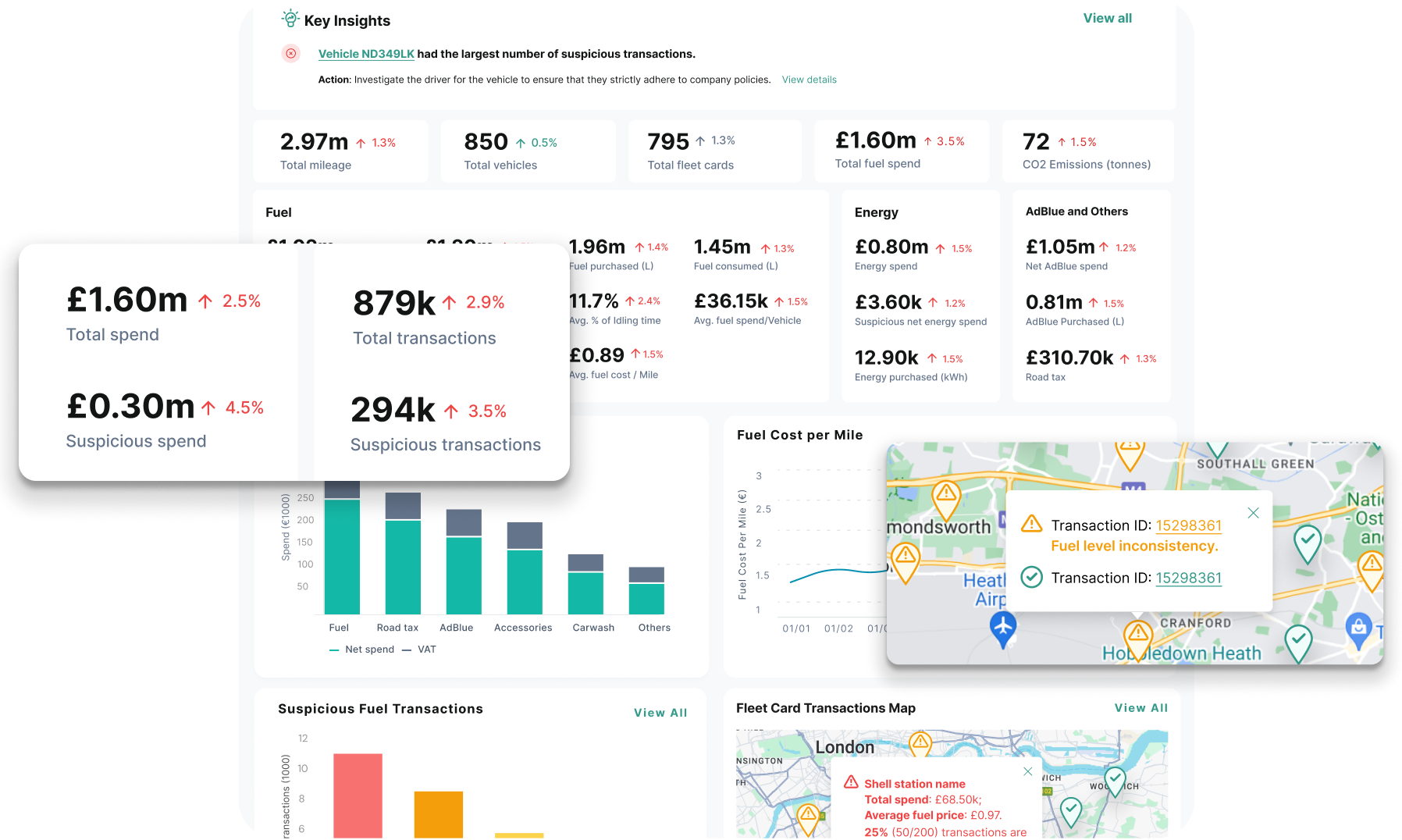
Fleevo picks out DEF purchases from your fuel card and onsite tank data and puts them next to diesel for every vehicle, in one fuel and energy view. You can see DEF spend by vehicle, driver, and site, compare it with each vehicle's diesel, and set plain-English rules such as "flag DEF bought on a gasoline vehicle" or "flag more than 10 gallons of DEF in one transaction." The same platform checks every diesel fill against telematics for location and fuel level, so DEF and diesel misuse show up in one place. Fleevo offers a free 3-month fuel audit, with the number back within 48 hours.
Book a demo, or read about fuel card spend controls that work and common fleet fuel fraud patterns.
DEF FAQs
How much DEF does a semi truck use?
About 2% of diesel consumed for most on-road trucks, or roughly 1 gallon of DEF for every 50 gallons of diesel. Some engines dose higher, at 3% to 5%. Check your engine manufacturer's figure.
Is DEF the same as AdBlue?
Yes. AdBlue is the trade name used in Europe and the UK. DEF is the same 32.5% urea solution, and the term used in the US.
How much does DEF cost?
In March 2026, the most common pump prices at Pilot Flying J were $4.299 to $4.599 a gallon. Jugs at retail usually cost more per gallon, and bulk delivery less.
How long does DEF last in storage?
It depends on temperature. Roughly 36 months at or below 50°F, 12 months at up to 86°F, and as little as 2 months near 104°F.
Can I stop drivers buying DEF on vehicles that don't need it?
Yes. Most fleet card programs support product controls per card, so you can block DEF on gasoline and non-SCR vehicles.
Sources
- Maryland Department of the Environment, SCR fact sheet: mde.maryland.gov
- Cummins, DEF bulletin: cummins.com
- FreightWaves, DEF pump prices, March 2026: freightwaves.com
- Ford Motorcraft, DEF shelf life and fluid quality: motorcraft.com
- EPA, diesel exhaust fluid: epa.gov
- EPA press release, March 2026: epa.gov
- WEX product controls: motorpasshelp.wexinc.com