
Hours of Service (HOS) rules cap how long a commercial driver can drive and work, and most interstate drivers must record them automatically with an Electronic Logging Device (ELD). The rules live in 49 CFR Part 395 and are enforced by the FMCSA. Here is what they require and who is exempt.
The Property-Carrying HOS Limits
- 11-hour driving limit: up to 11 hours of driving after 10 consecutive hours off duty.
- 14-hour window: no driving beyond the 14th consecutive hour after coming on duty, even if not all of it was spent driving.
- 30-minute break: required after 8 cumulative hours of driving; on-duty not-driving time now counts as the break.
- 60/70-hour limit: no driving after 60 hours on duty in 7 days, or 70 in 8, depending on your operating schedule.
- 34-hour restart: the weekly clock resets after 34 consecutive hours off duty.
Two flexibilities matter in practice: the sleeper-berth provision lets drivers split the 10 hours off duty (as 7 and 3, or 8 and 2), and the adverse driving conditions exception allows up to 2 extra hours when conditions could not have been known before departure.
Who Needs an ELD?
Drivers who are required to keep records of duty status generally must use an ELD. The main exemptions are short-haul drivers who stay within a 150 air-mile radius and return within 14 hours, drivers who keep records of duty status no more than 8 days in any 30, driveaway-towaway operations, and vehicles with an engine older than model year 2000.
Why HOS Data Is Worth More Than Compliance
The same records that prove HOS also describe how hard each vehicle and route is worked, which is exactly what maintenance scheduling, duty-cycle analysis and cost per mile need. Driver identity and on-duty time tie a fuel transaction or a fine to the person and shift behind it. Treated only as a compliance file, that data is wasted.
Frequently Asked Questions
What is the 11-hour rule?
A property-carrying driver may drive up to 11 hours after 10 consecutive hours off duty.
Does on-duty time count against the 14-hour window?
Yes. The 14-hour window runs from when the driver comes on duty and includes breaks and non-driving work. Only 10 or more consecutive hours off duty resets it.
Who is exempt from the ELD mandate?
Mainly short-haul drivers within a 150 air-mile radius, those keeping paper logs 8 or fewer days in 30, driveaway-towaway operations, and vehicles with a pre-2000 engine.
Is a tachograph the same as an ELD?
No. Tachographs are the EU and UK system; the US uses ELDs under FMCSA rules. They record similar things under different regulations. See tachograph data hosting and integration for the EU side.
#1 AI-powered fleet spend control platform
Ready to Stop Losing Money on Fleet Spend?
See how much you could save in the first week. Start your free trial today. Cancel anytime.
How Fleevo Uses Your HOS and Telematics Data
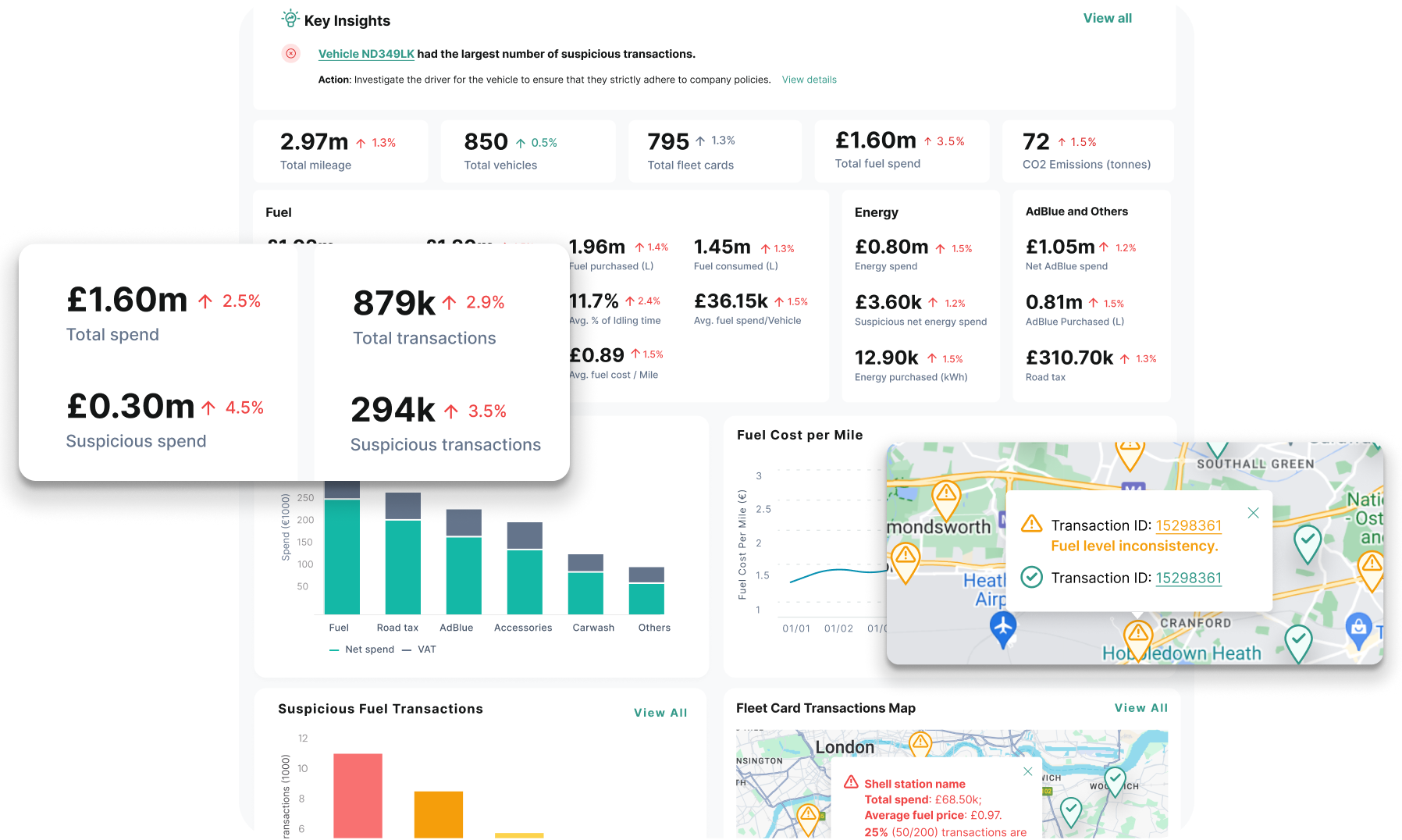
Fleevo is not an ELD and does not manage hours of service; your telematics or ELD provider does that. Fleevo consumes the driver, vehicle and mileage data alongside fuel and maintenance, so a fuel exception or a fine can be attributed to the right vehicle and shift, and so per-jurisdiction miles feed IFTA. Fleevo is an official partner of Samsara, Geotab and Verizon Connect and integrates with other providers. See the US fleet compliance guide, what is IFTA, and CSA scores and DOT audits.