
Knowing what your fleet costs in total is a start. Knowing which department, contract, or customer each cost belongs to is what makes the number useful. Fleet cost allocation assigns every cost to the right place, so budgets, chargebacks, and profit-and-loss reflect reality. Here is how it works.
What Is Fleet Cost Allocation?
Fleet cost allocation is the process of assigning fleet costs to the cost center, department, project, or customer that incurred them. Where cost-per-vehicle answers what a van costs, cost allocation answers who that cost should be charged to. The two work together: costs are captured at the vehicle level, then rolled up to the right business unit.
Why Allocate Fleet Costs?
- Accurate chargebacks. Bill internal departments or customers for the fleet costs they actually generate.
- Real profit and loss. See which contracts and routes are profitable once fleet costs are included.
- Accountability. Cost visible by team or manager encourages better decisions.
- Fair budgeting. Each cost center's budget reflects its real fleet usage.
Which Costs Get Allocated
All of the usual fleet lines: fuel and energy, maintenance, insurance, leasing, fines, and tolls. Some are directly tied to a vehicle or job; others, like shared overhead, are apportioned by a rule such as mileage, days used, or vehicle count.
How to Allocate Fleet Costs
- Capture costs at the vehicle level. Start with clean, per-vehicle data.
- Tag the business dimension. Assign each vehicle or cost to a cost center, department, contract, or customer.
- Apportion shared costs. Split overhead by an agreed rule.
- Report by dimension. Roll costs up by whatever view the business needs.
#1 AI-powered fleet spend control platform
Ready to Stop Losing Money on Fleet Spend?
See how much you could save in the first week. Start your free trial today. Cancel anytime.
How Fleevo Handles Cost Allocation
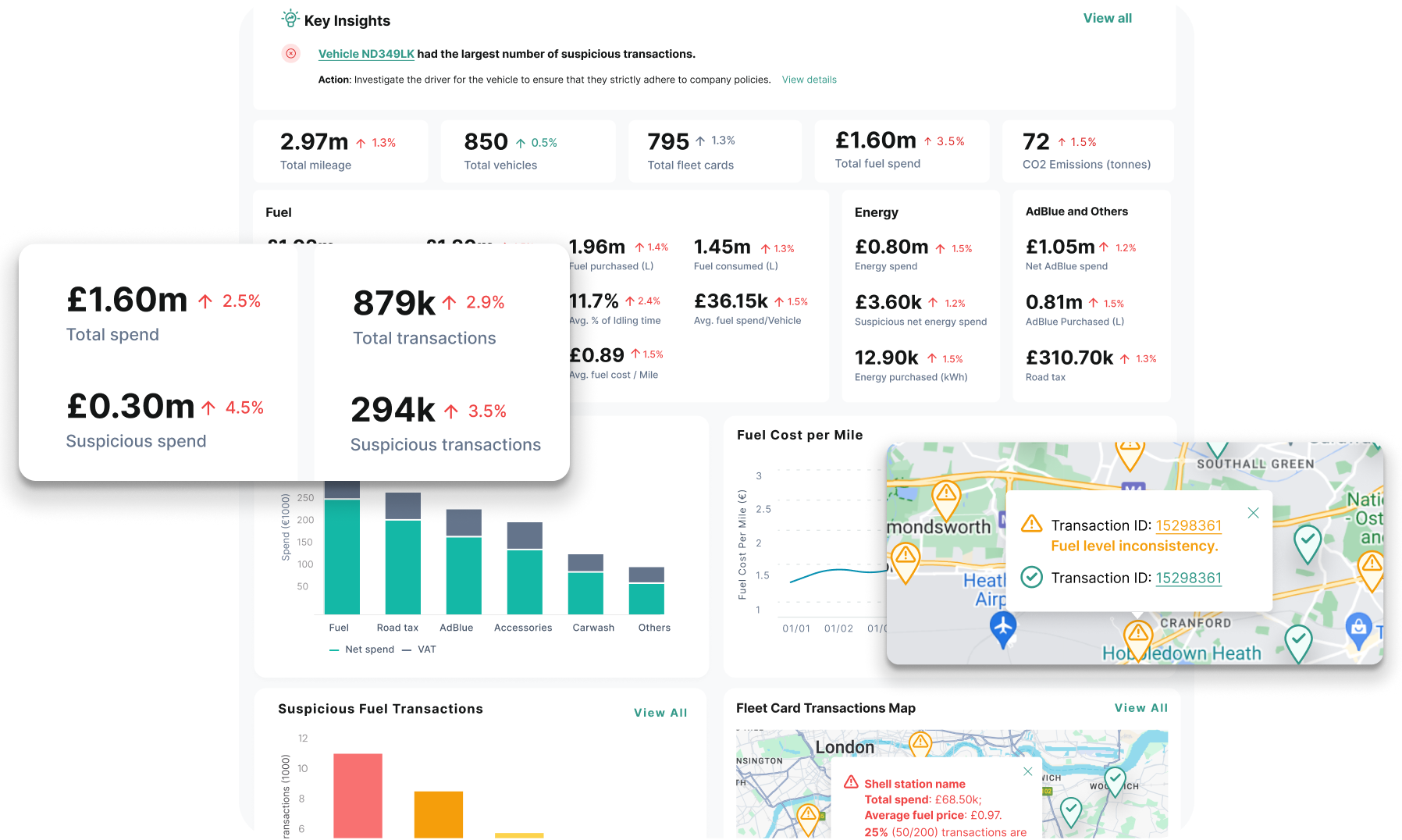
Fleevo captures every fleet cost at the vehicle level, then lets you roll those costs up by cost center, department, contract, or customer, so chargebacks and profit-and-loss are accurate without manual spreadsheets. Because the underlying data is checked and reconciled automatically, the numbers you allocate are numbers you can trust. See fleet invoice management for the vehicle-level foundation, or explore Fleet TCO.
Fleet Cost Allocation FAQs
What is the difference between cost allocation and cost per vehicle?
Cost per vehicle tells you what an individual asset costs. Cost allocation assigns those costs to a cost center, department, contract, or customer. The first is the input; the second is how the business uses it.
How do you allocate shared fleet costs?
Shared or overhead costs are apportioned by an agreed rule, such as mileage, days in use, or number of vehicles, so each cost center carries a fair share.
Why does cost allocation matter?
It enables accurate chargebacks, real per-contract profit and loss, and fair budgets, none of which are possible when fleet cost is only known as a single total.
Explore the platform: Fleet TCO.
Cost allocation is how TCO reaches a cost centre; see the pillar guide on how to reduce fleet TCO.