
If your fuel spend has crept up and you can't explain why, you're not alone — and jumping to “a driver must be stealing” is the wrong first move. Fleets lose roughly 2–5% of annual fuel spend to fraud and misuse, but a large share of “missing” fuel turns out to have an innocent explanation. The goal isn't to catch someone; it's to find out what's actually happening, fairly and with evidence.
Here are the warning signs worth investigating, the harmless causes to rule out first, and how to verify the truth before you ever have a difficult conversation.
Warning Signs of Fuel Loss in a Fleet
These patterns are worth a closer look — not proof of anything on their own, but signals that something needs explaining:
- Fuel bought when the vehicle wasn't there: a card transaction at a station the vehicle's GPS never visited.
- Fills bigger than the tank: more gallons purchased than the tank physically holds.
- MPG that's drifted: a vehicle's fuel economy quietly worsening without a mechanical reason.
- Weekend or out-of-hours fills on vehicles that weren't scheduled to work.
- Repeat fills close together: two fills within an hour, or several in a day.
- Depot tank shrinkage: onsite fuel dropping faster than dispensing records account for.
- Wrong fuel type for the vehicle on the card.
Rule Out the Innocent Explanations First
Most anomalies aren't theft. Before suspecting anyone, check whether the cause is one of these:
- Idling and driving style: heavy idling, cold-weather running, or a heavy right foot can push MPG down legitimately.
- Route or load changes: more miles, heavier loads, or hillier routes burn more fuel.
- Data and admin errors: a fill logged against the wrong vehicle, a mistyped odometer reading, or a delayed transaction date.
- Misfueling: an honest mistake at the pump, not deliberate abuse.
- Card cloning by outsiders: skimmed card details used by criminals — the driver is a victim, not a culprit.
- Tank leaks or faulty gauges: mechanical causes of “disappearing” fuel, especially on depot tanks.
Ruling these out first protects good drivers from false accusations — and keeps you focused on what's genuinely unexplained.
How to Investigate Fuel Loss Fairly
- Verify with data, not hunches
Match every suspicious transaction against the vehicle's location, tank capacity, fuel level, and mileage at that moment. Facts, not suspicion, should drive the next step. - Establish a pattern, not a one-off
A single odd fill is usually an error. A repeated pattern across weeks is what warrants investigation. - Bring in all fuel sources
Cards, onsite tanks, and off-card purchases together — loss often hides in the gaps between systems. - Document before you discuss
If you do raise it with a driver, come with specific, verifiable evidence, not a general accusation. It's fairer, and it's on firmer legal ground. - Fix the process, not just the person
Vehicle-locked cards, PINs, product restrictions, and continuous monitoring prevent recurrence — whatever the original cause turned out to be.
#1 AI-powered fleet spend control platform
Ready to Stop Losing Money on Fleet Spend?
See how much you could save in the first week. Start your free trial today. Cancel anytime.
Why Manual Checks Miss Fuel Loss
Fuel loss hides inside ordinary-looking transactions, spread thin across months. Reviewing statements by hand can't reliably catch a fill 30 miles off route or a gallon count that quietly exceeds tank capacity — there are simply too many transactions. That's why most fuel loss goes unnoticed until the annual numbers look wrong, by which point the trail is cold.
How Fleevo Helps You Find the Truth
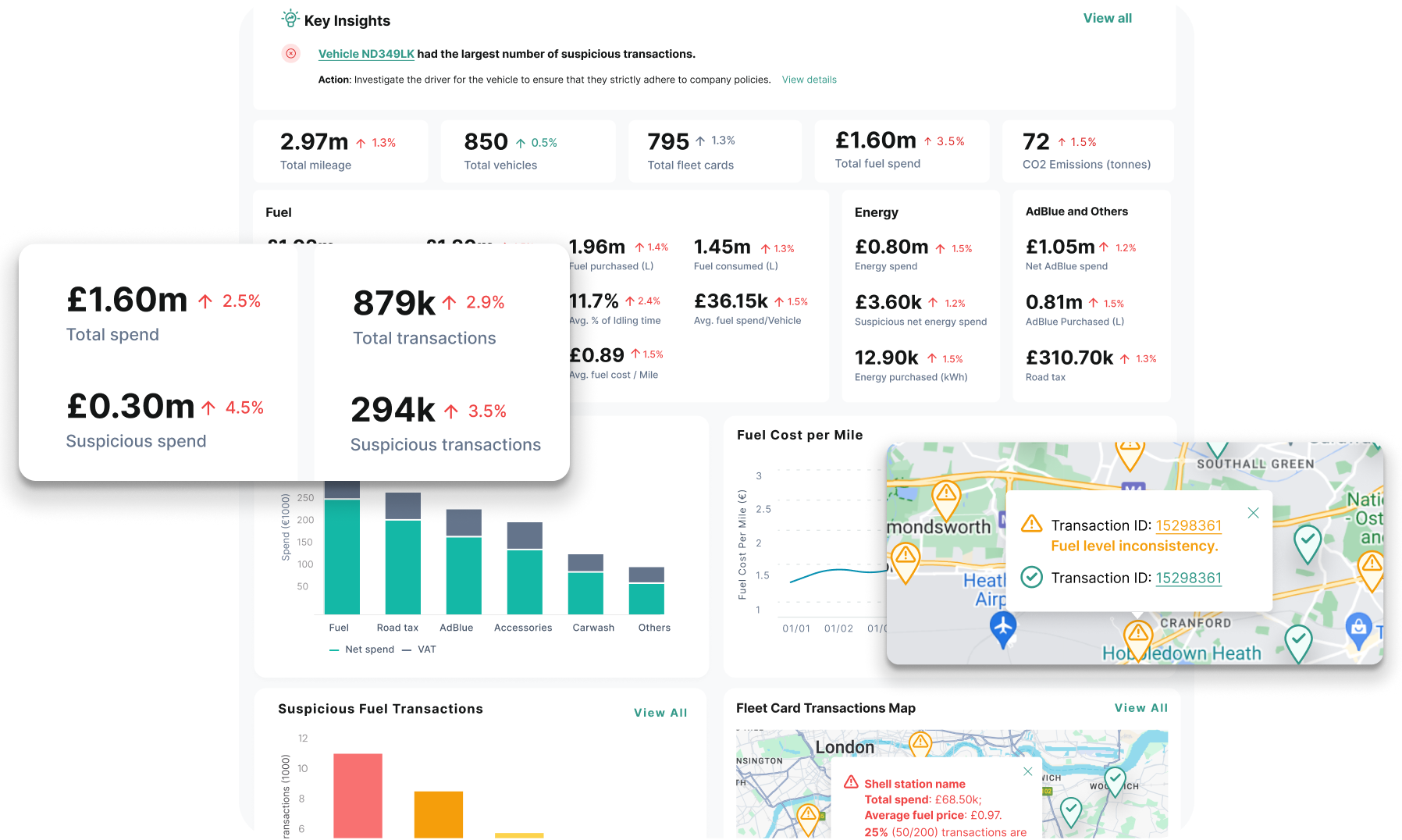
Fleevo connects your fuel cards, onsite tanks, and telematics and checks every transaction automatically against vehicle location, tank capacity, fuel level, and fuel type — separating genuine anomalies from innocent ones and giving you the evidence to act fairly. It's a continuous fuel audit rather than a one-off investigation, so problems surface as they happen. See how Egertons Recovery strengthened fuel oversight with Fleevo.
Fuel Theft Investigation FAQs
How do I know if fuel is being stolen or just wasted?
Verification is the only reliable way. Theft shows up as fuel that can't be reconciled to a vehicle — a fill where the vehicle wasn't present, or volumes exceeding tank capacity. Waste (idling, driving style, heavier routes) shows up as higher consumption that still matches the vehicle's real activity. Cross-referencing transactions against telematics tells them apart.
Can I accuse a driver based on fuel data?
Approach it as investigation, not accusation. Use data to establish a clear, repeated, verifiable pattern, document it, and follow your organization's fair disciplinary process. A single anomaly is rarely proof, and wrongful accusations carry real legal and morale costs.
What's the most common cause of unexplained fuel loss?
Across typical fleets it's a mix: driver misuse like personal fill-ups, but also plenty of non-theft causes — idling, data errors, misfueling, and card cloning by outsiders. That's exactly why verifying before suspecting matters.
Bottom line: unexplained fuel loss deserves investigation, not accusation. Rule out the innocent causes, verify the rest against hard vehicle data, and you'll know what's really happening — and protect your good drivers in the process.
Prevention: once you know what's happening, see how to prevent fuel theft with card controls and monitoring.
Explore the platform: Fuel & Energy Management · What is Fuel Card Fraud?