
An onsite fuel tank is the cheapest way to fuel a fleet that returns to a yard, and the easiest place to lose fuel without noticing. Fuel card transactions come with a station, a time, and a card number. A yard tank often has a dispenser log, a delivery ticket, and a stick reading on a clipboard. If those three numbers are not compared regularly, gallons go missing and nobody can say where.
Tank reconciliation is the comparison. This guide covers how to do it, what variance is normal, and how to trace the gallons that do not add up.
The basic equation
For any period, usually a day or a month:
Opening inventory + deliveries − gallons dispensed = expected closing inventory
Compare that with the actual closing inventory, measured by stick or automatic tank gauge (ATG). The difference is your variance. A small variance is normal. A large or growing one means fuel is leaving the tank without being recorded, or never arrived.
What variance is normal?
For underground storage tanks, EPA's inventory control method gives a benchmark. Under 40 CFR 280.43, monthly inventory control must be able to detect a release of 1.0% of flow-through plus 130 gallons. EPA's guide explains the calculation: take the gallons pumped in the month, drop the last two digits to get 1%, and add 130.
A tank that dispensed 12,000 gallons in a month has an allowable variance of 120 + 130 = 250 gallons. Beyond that, EPA says the tank may be leaking.
Two caveats:
- This is a leak detection rule, not a theft threshold. 250 gallons of diesel a month is around $10,000 a year at $3.50 to $4 a gallon. For loss control, most fleets set a much tighter internal limit and investigate trends, not just breaches.
- Inventory control is never enough on its own for compliance. EPA requires it to be paired with another release detection method, and tanks installed after April 2016 need interstitial monitoring. Aboveground tanks fall under EPA's SPCC rule instead, which covers spill prevention, not inventory reconciliation. Check your state's rules too.
Where the gallons go
Temperature
Fuel expands when warm and contracts when cold. Gasoline changes volume by about 0.069% per °F, and diesel slightly less. Wholesale fuel has been traded on a 60°F basis for decades, so if your delivery ticket bills net (temperature-corrected) gallons and you measure gross gallons in the tank, a summer delivery will measure higher than the ticket and a winter one lower. Check which basis your ticket uses. EPA's guide tells tank owners to reconcile against the gross figure where both are shown.
Meter error
NIST Handbook 44 allows a fleet-style dispenser (1 to 30 gallons per minute) to be up to 0.5% out in service. Over a year, small meter drift adds up to real variance. Calibrate on a schedule.
Short deliveries
A delivery ticket is the supplier's number, not yours. A New York City investigation into heating oil deliveries found drivers overriding meter protections and pumping air into meters to inflate readings, and led to arrests at 53 delivery companies. Fleet diesel deliveries face the same risk. The city's advice applies directly: measure the tank immediately before and after every delivery, re-measure 30 minutes later, and compare with the ticket before you pay.
Unrecorded dispensing
Fuel drawn without a valid key, card, or PIN, a pump left authorized between vehicles, or a driver entering the wrong vehicle number. The fuel left the tank but went against the wrong vehicle, or no vehicle.
Theft
Fuel drawn into jerry cans, personal vehicles, or equipment that is not yours. This is where reconciling the tank alone runs out: it tells you fuel is missing, not which fills were the problem.
Leaks
Steady, unexplained loss that does not follow dispensing patterns. Treat a persistent shortage as a possible leak until proven otherwise.
Reconciling the tank is half the job
Tank reconciliation answers "is fuel missing from the tank?" It does not answer "did each gallon dispensed go into the vehicle it was recorded against?" For that, you need to check the dispensing side, transaction by transaction:
- Was the vehicle at the yard when the fill was recorded? Telematics shows whether the truck was actually at the tank.
- Did the vehicle's fuel level rise by the amount dispensed? A 60-gallon fill on a truck whose fuel level did not change means the fuel went somewhere else.
- Does the volume fit the vehicle's tank? A fill larger than the tank can hold is never legitimate.
- Does consumption make sense? Gallons dispensed against miles driven, per vehicle, combining onsite fills and fuel card fills.
Fleets with both onsite tanks and fuel cards need these checks across both sources. A vehicle that fills half from the yard and half on a card looks normal in each system and only shows a problem when you add them up.
A practical reconciliation routine
- Daily: record ATG or stick readings and dispensed gallons. Flag any day with an unusual variance.
- Every delivery: measure before and after, re-measure after 30 minutes, and compare with the ticket. Note whether the ticket is net or gross.
- Weekly: review dispensing transactions against telematics for location, fuel level rise, and tank size.
- Monthly: calculate variance against your internal limit and EPA's 1% plus 130 gallons benchmark, and look at the trend.
- Every six to twelve months: calibrate dispenser meters and check the ATG.
#1 AI-powered fleet spend control platform
Ready to Stop Losing Money on Fleet Spend?
See how much you could save in the first week. Start your free trial today. Cancel anytime.
How Fleevo audits onsite fuel
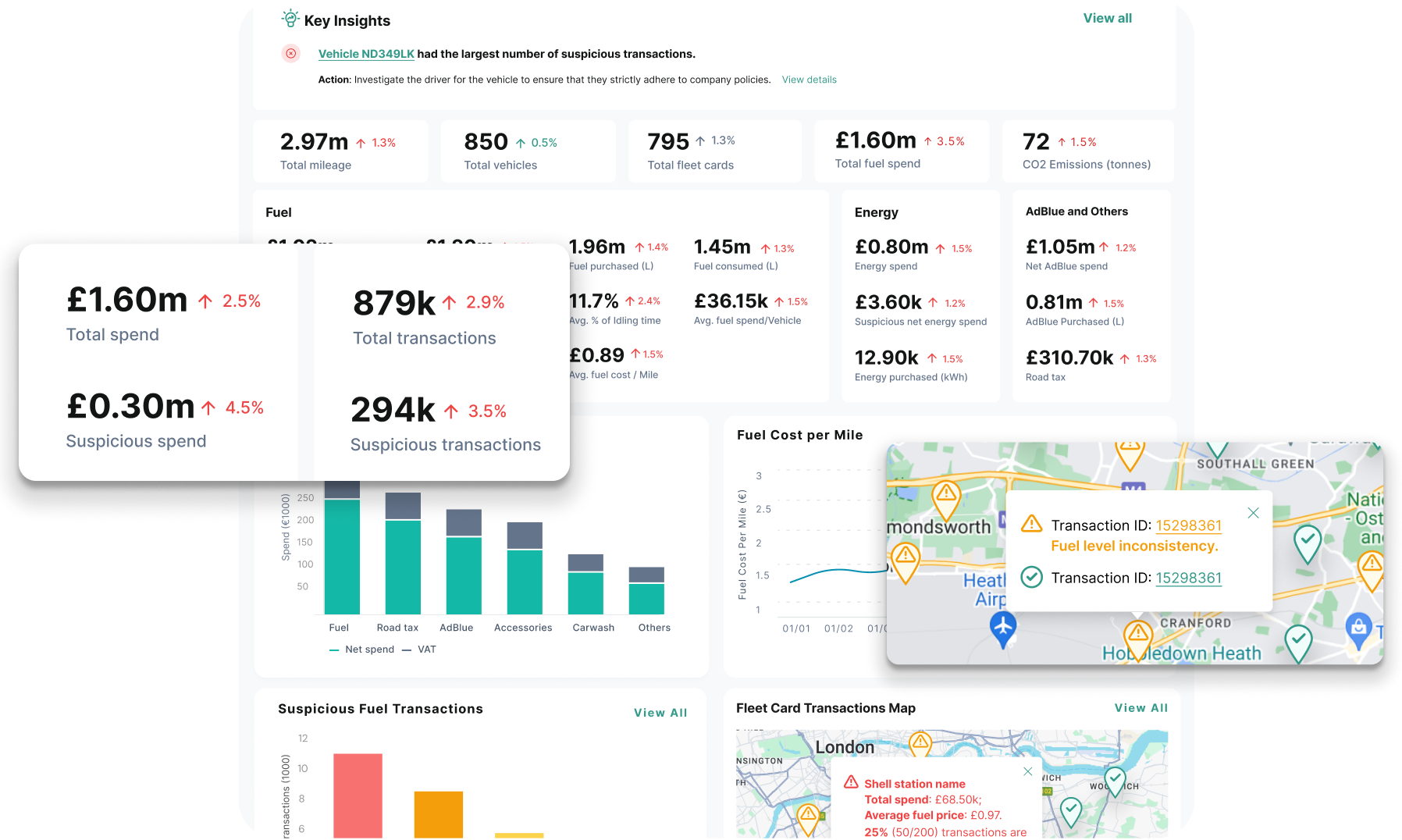
Fleevo takes in dispensing transactions from onsite tank systems, including FuelCloud, and checks each one against your telematics: was the vehicle at the tank at that time, did its fuel level rise by the gallons dispensed, and does the volume fit its tank. Onsite fills sit next to fuel card fills for every vehicle, so you see true consumption across both and catch the gaps neither system shows on its own. Fleevo is an official partner of Samsara, Geotab, and Verizon Connect, and offers a free 3-month fuel audit, with the number back within 48 hours.
Book a demo, or read about fleet fuel reconciliation and how to prevent fuel theft in fleets.
Onsite fuel tank FAQs
How do you reconcile a fuel tank?
Add deliveries to your opening inventory, subtract gallons dispensed, and compare the result with the measured closing inventory. The difference is your variance.
What is an acceptable fuel tank variance?
For underground tanks, EPA's inventory control benchmark is 1.0% of monthly flow-through plus 130 gallons. That is a leak detection threshold. Most fleets set a tighter internal limit for loss control.
Why does my tank show more fuel than was delivered?
Usually temperature. If the delivery ticket bills temperature-corrected (net) gallons and the fuel arrives warmer than 60°F, it occupies more volume in your tank than the ticket shows.
Do aboveground fuel tanks need inventory reconciliation?
EPA's underground tank rules do not apply to aboveground tanks, and EPA's SPCC rule for aboveground storage focuses on spill prevention. State rules vary, and reconciliation is still the only way to know whether fuel is going missing.
How do I know if fuel is being stolen from my yard tank?
Look for variance that grows over time, and check each dispensing transaction against telematics: whether the vehicle was at the yard, and whether its fuel level rose by the amount dispensed.
Sources
- 40 CFR 280.43, release detection methods: law.cornell.edu
- 40 CFR 280.41, release detection requirements: law.cornell.edu
- EPA, release detection for underground storage tanks: epa.gov
- EPA, Doing Inventory Control Right: epa.gov
- EPA, who is regulated by the SPCC rule: epa.gov
- NIST Handbook 44 (2026), section 3.30: nist.gov
- US House Domestic Policy Subcommittee, hot fuel report (2007): consumerwatchdog.org
- NYC Department of Investigation, fuel oil delivery report (2015): nyc.gov