
Most finance teams detect fuel card abuse late, if at all, because the data they work from is aggregated to a level where individual abuse is invisible. A monthly fuel accrual that lands within 3 percent of forecast looks like control. It is entirely consistent with a steady leak, because the leak is inside the forecast.
This matters because fuel is usually the second largest controllable cost in a fleet, and unlike labour or premises it is spent thousands of times a month by people who are not in the finance function.
Why the usual controls do not find it
- Variance analysis against budget. Detects a step change, not a persistent baseline. Abuse that has been happening since before the budget was set is inside the baseline.
- Approving the supplier invoice. Confirms the card provider billed what it says it dispensed. It says nothing about whether the fuel entered the right vehicle.
- Cost centre reporting. Aggregates away the individual transaction, which is the only level at which misuse is visible.
- Sampling. Works for high value, low volume spend. Fuel is the opposite profile, so a 5 percent sample of low value transactions has almost no chance of finding a pattern.
None of these are bad controls. They are simply aimed at a different risk from the one fuel presents.
The four controls that do work
1. Transaction level exception reporting, not aggregate reporting. Every transaction tested against the vehicle it was assigned to: location, volume against tank capacity, product type, and implied consumption. Finance receives exceptions with evidence, not a spend total.
2. Three way fuel reconciliation. Card statement volume, onsite tank dispensed volume, and telematics consumption should broadly agree. Where they do not, the gap is either a data problem or a loss, and quantifying it monthly gives finance a genuine assurance number rather than a plausible total.
3. Cost per mile by vehicle, compared within class. The vehicles at the wrong end of their own class distribution are where to look. This is the single most useful report finance can own, because it needs no fraud hypothesis to be useful and it also surfaces maintenance and utilisation problems.
4. Segregation between card administration and card reconciliation. Whoever issues, blocks and sets limits on cards should not be the person who signs off the monthly reconciliation. This is basic and frequently absent in fleets under about 200 vehicles.
What to ask for from the fleet team
Finance teams often cannot get these controls running because the underlying data is held operationally. Four specific asks:
- A vehicle to card mapping that is maintained, with a documented process for reassignment
- Telematics odometer readings monthly per vehicle, not just at service
- Tank capacity recorded per vehicle in the asset register
- Onsite tank delivery and dip records in a digital format
None of these are large projects. The absence of the last two is the usual reason a reconciliation cannot be built.
Presenting findings without wrecking relationships
Fuel exceptions are personal in a way that a supplier pricing variance is not. Two practical rules: never send an unverified flag to a line manager, and always distinguish clearly between confirmed loss, unexplained variance, and data quality issues. Conflating those three is the fastest way to lose the fleet team's cooperation, and the fleet team's cooperation is what makes the control work.
#1 AI-powered fleet spend control platform
Ready to Stop Losing Money on Fleet Spend?
See how much you could save in the first week. Start your free trial today. Cancel anytime.
Giving Finance The Exception Report In Fleevo
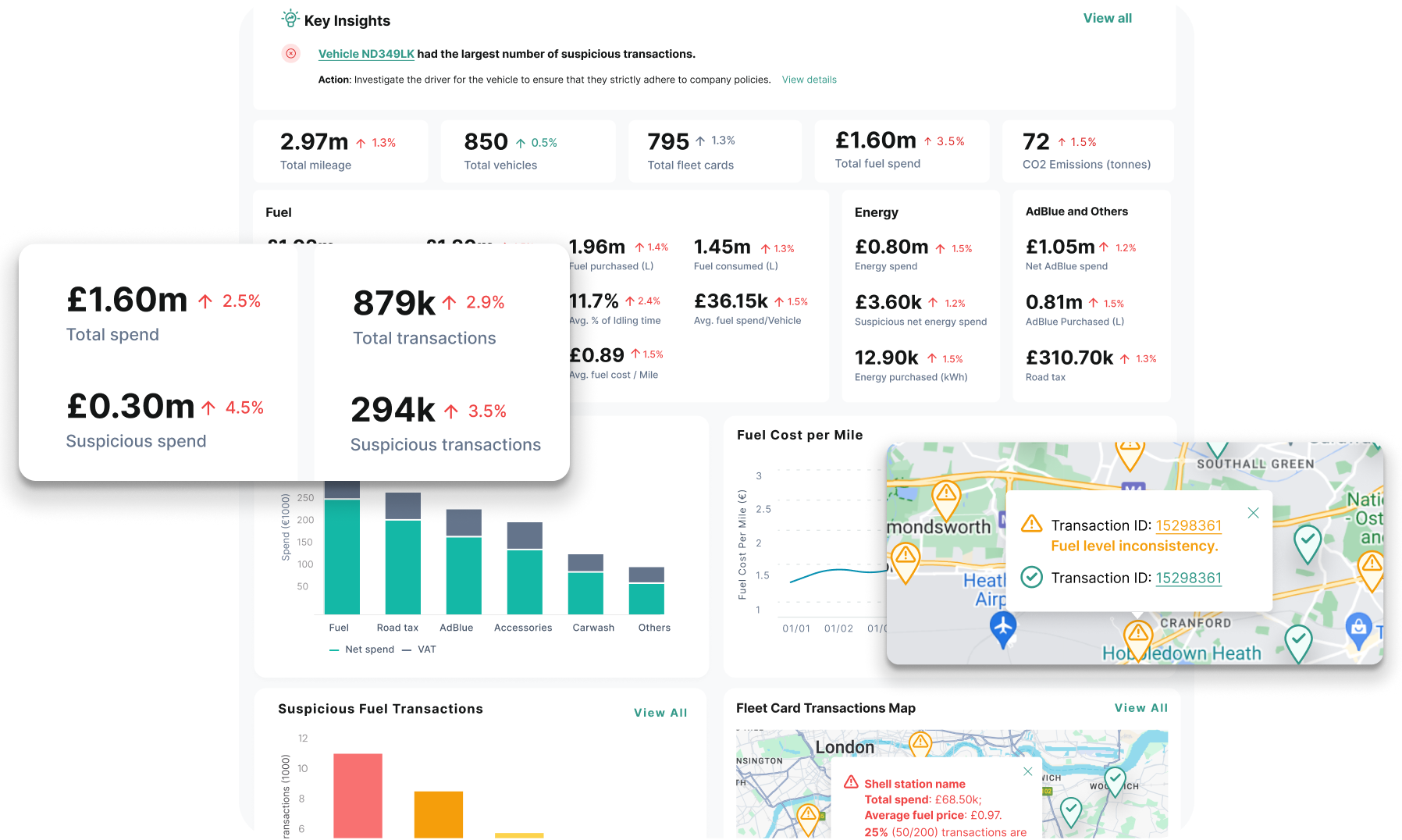
Fleevo produces transaction level exception reporting with the supporting vehicle evidence attached, three way reconciliation across fuel cards, onsite tanks and charge points, and cost per mile by vehicle within class. Finance and fleet see the same records, which removes the usual argument about whose numbers are right. To see the reconciliation on your own data, contact Fleevo or book a demo. See also fuel and EV charge management, fleet fuel reconciliation, and the fuel fraud patterns we see most often.
Finance Team FAQs
How do finance teams typically identify fuel card abuse?
In most organisations, by accident: a fuel spend outlier noticed during month end, or a tip off. Systematic detection needs transaction level testing against vehicle data, which is a different report from anything finance normally receives.
What tools help finance teams detect fuel and fleet expense fraud?
Any tool that joins fuel and charge transactions to vehicle telematics and asset data, and tests each transaction rather than summarising it. Expense management platforms handle policy compliance well but generally cannot test a fuel transaction against vehicle position, because they do not hold vehicle data.
Can this be done in a spreadsheet?
A one off review, yes, and it is worth doing to size the problem. Monthly, no, because the joins between card statements, telematics exports and the asset register break every time a card is reassigned or a vehicle changes, and that maintenance burden is what kills spreadsheet controls after two or three cycles.
What assurance can finance realistically give on fuel spend?
With three way reconciliation running, finance can state what proportion of fuel volume is corroborated against vehicle activity and quantify the unexplained remainder. That is a far stronger position than confirming the invoice matched the statement.
Who should own the fuel exception process?
Finance should own the reconciliation and the assurance number; fleet should own investigating and closing individual exceptions. Splitting it that way preserves segregation of duties and keeps the fleet team engaged rather than audited.