
An employer cannot check a non-GB driving licence with the DVLA, because the DVLA holds no record of it. The check has to be done from the licence itself, plus the rules on how long that driver may drive in Great Britain on it. Those rules depend on where the licence was issued, whether the driver lives in Great Britain, and the type of vehicle.
This guide covers how long staff can drive on a non-GB licence, when they must exchange it, and how to check these drivers so they are not the gap in your licence checks. For checking GB licences, see our driver licence checks guide.
How long can staff drive on a non-GB licence?
For drivers who live in Great Britain, GOV.UK sets these rules for a full, valid car licence:
| Where the licence is from | How long they can drive in GB |
|---|---|
| EU or EEA | Until age 70, if they were under 67 when they became resident. 3 years from becoming resident if they were 67 or older |
| A designated country (for example Canada, Hong Kong or the UAE), Gibraltar, Jersey, Guernsey or the Isle of Man | 12 months from becoming resident, and they can exchange it for a GB licence within 5 years |
| Ukraine (Ukraine visa schemes) | At least 3 years from becoming resident |
| Any other country | 12 months from becoming resident. After that they need a GB provisional licence and must pass the theory and practical tests |
Visitors, rather than residents, can drive for up to 12 months on a full, valid EU or EEA licence. An EU licence that was itself obtained by exchanging a non-EU licence only covers 12 months in Great Britain.
Lorry and bus licences have shorter limits
For lorry, minibus and bus entitlements, the rules are tighter. A driver resident in Great Britain with an EU or EEA lorry or bus licence can drive until they are 45, or for 5 years after becoming resident. Drivers aged 45 to 65 can drive for 5 years or until they are 66. Drivers of vehicles over 3.5 tonnes must register their details with the DVLA within 12 months of becoming resident.
Professional drivers also need a valid Driver CPC and a tachograph card, so track those alongside the licence. See drivers' hours and tachograph rules.
Exchanging a non-GB licence
Drivers exchange an eligible licence by sending form D1, the £43 fee and their licence to the DVLA. For designated countries, they have 5 years from becoming resident. Once exchanged, the driver has a GB licence and you can check it with the DVLA like any other.
Encouraging eligible drivers to exchange is the simplest way to bring them into your normal checks. Until they do, they need a manual check.
How to check a non-GB licence
- See the original licence. Check the photo matches the driver, the categories cover the vehicle they will drive, and the licence is in date.
- Record when the driver became resident. The 12 month and 5 year limits run from that date, so without it you cannot tell when their right to drive ends.
- Keep a copy. Store photos of the front and back with the date you checked and who checked it.
- Set a review date. Diary the date the right to drive ends, and the licence expiry, whichever comes first.
- Recheck on a schedule. Ask the driver to confirm, at the same interval as your GB checks, that their licence is still valid and they have no bans or penalties abroad.
Northern Ireland licences
Northern Ireland licences are UK licences, but they are issued by the DVA, not the DVLA. A DVLA check does not cover them, so they need the DVA's own check or a manual check of the licence.
Where non-GB drivers fall through the gaps
- Agency and temporary drivers, who often start before anyone checks their licence.
- Drivers whose 12 months run out. The licence is still in date, so nothing looks wrong, but the right to drive on it in Great Britain has ended.
- Paper records. Photos in an inbox or a shared drive, with no reminder when a review is due.
A non-GB driver needs the same duty of care as everyone else. They just cannot be covered by a DVLA check.
#1 AI-powered fleet spend control platform
Ready to Stop Losing Money on Fleet Spend?
See how much you could save in the first week. Start your free trial today. Cancel anytime.
How Fleevo checks non-GB licences
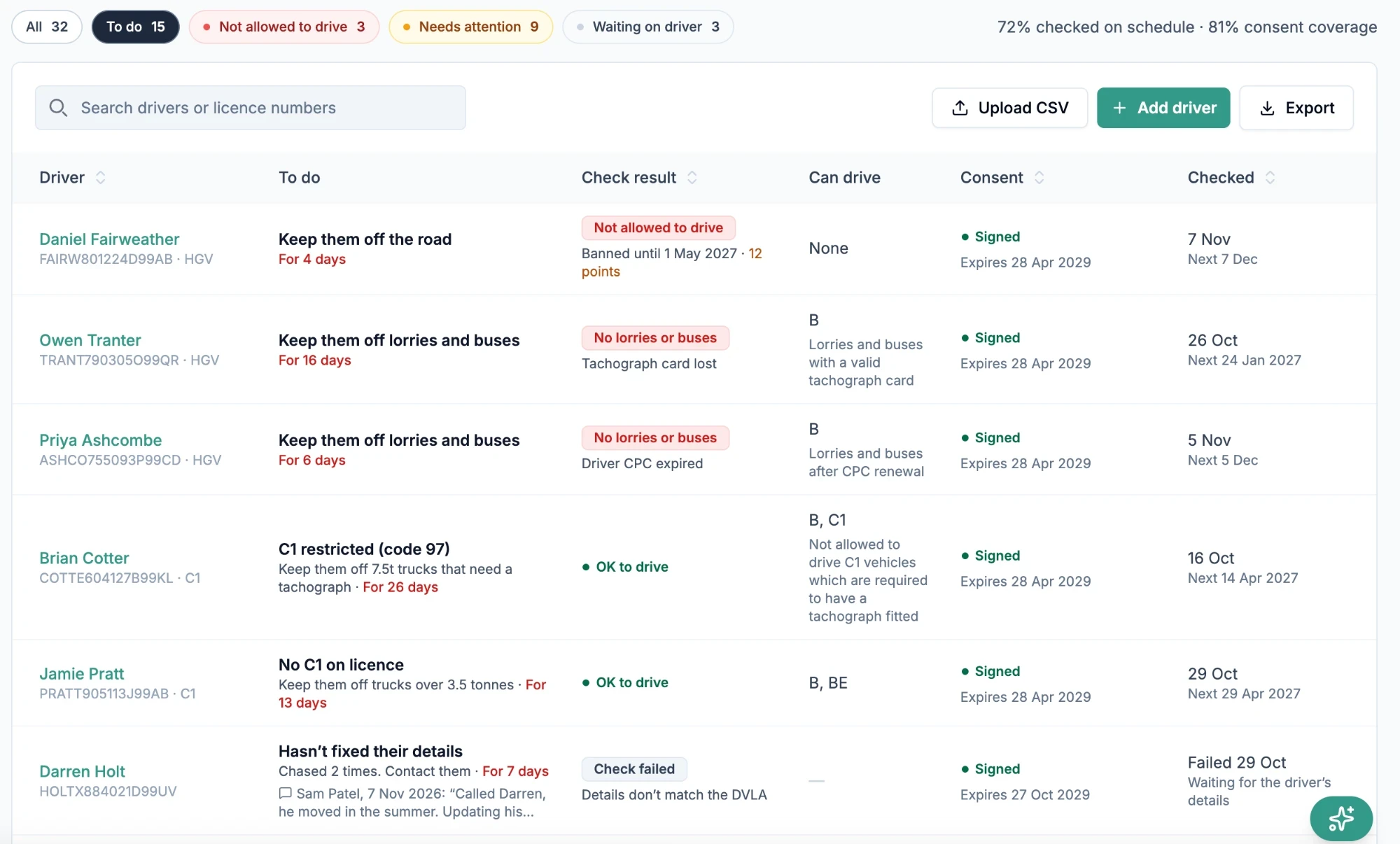
Fleevo checks GB licences against DVLA records automatically, and handles non-GB licences in the same place. Drivers with a non-GB licence upload photos of the front and back from their phone, and a manager approves them. Every driver, GB or not, sits on one list with their licence status and the next date something needs attention, and the CSV export includes both. Agency drivers with a GB licence can be checked with a share code. Explore Fleevo driver licence checks, or talk to us.
Non-GB driving licence FAQs
Can an employer check a foreign driving licence with the DVLA?
No. The DVLA only holds records for GB licences. Check the original licence, record when the driver became resident, and keep a copy.
How long can I drive in the UK on an EU licence?
If you live in Great Britain and became resident before 67, until you are 70. Lorry and bus entitlements have shorter limits.
How long can I drive in the UK on a non-EU licence?
12 months from becoming resident. Licences from designated countries can then be exchanged within 5 years. Others need a GB provisional licence and a driving test.
How much does it cost to exchange a foreign driving licence?
£43, using form D1 from the DVLA.
Can Northern Ireland licences be checked with the DVLA?
No. Northern Ireland licences are issued by the DVA and need a separate check.
Do non-GB lorry drivers need a Driver CPC?
Yes. Professional lorry and bus drivers need a valid Driver CPC and tachograph card, whatever country issued their licence.
Related: driver licence checks guide, DVLA licence check cost, grey fleet licence checks.
This is general information, not legal advice. Confirm a driver's position with GOV.UK's non-GB licence checker.
Sources
- GOV.UK, Driving in Great Britain on a non-GB licence: https://www.gov.uk/driving-nongb-licence
- GOV.UK, Exchange a non-GB driving licence: https://www.gov.uk/exchange-foreign-driving-licence
- GOV.UK, View or share your driving licence information: https://www.gov.uk/view-driving-licence