

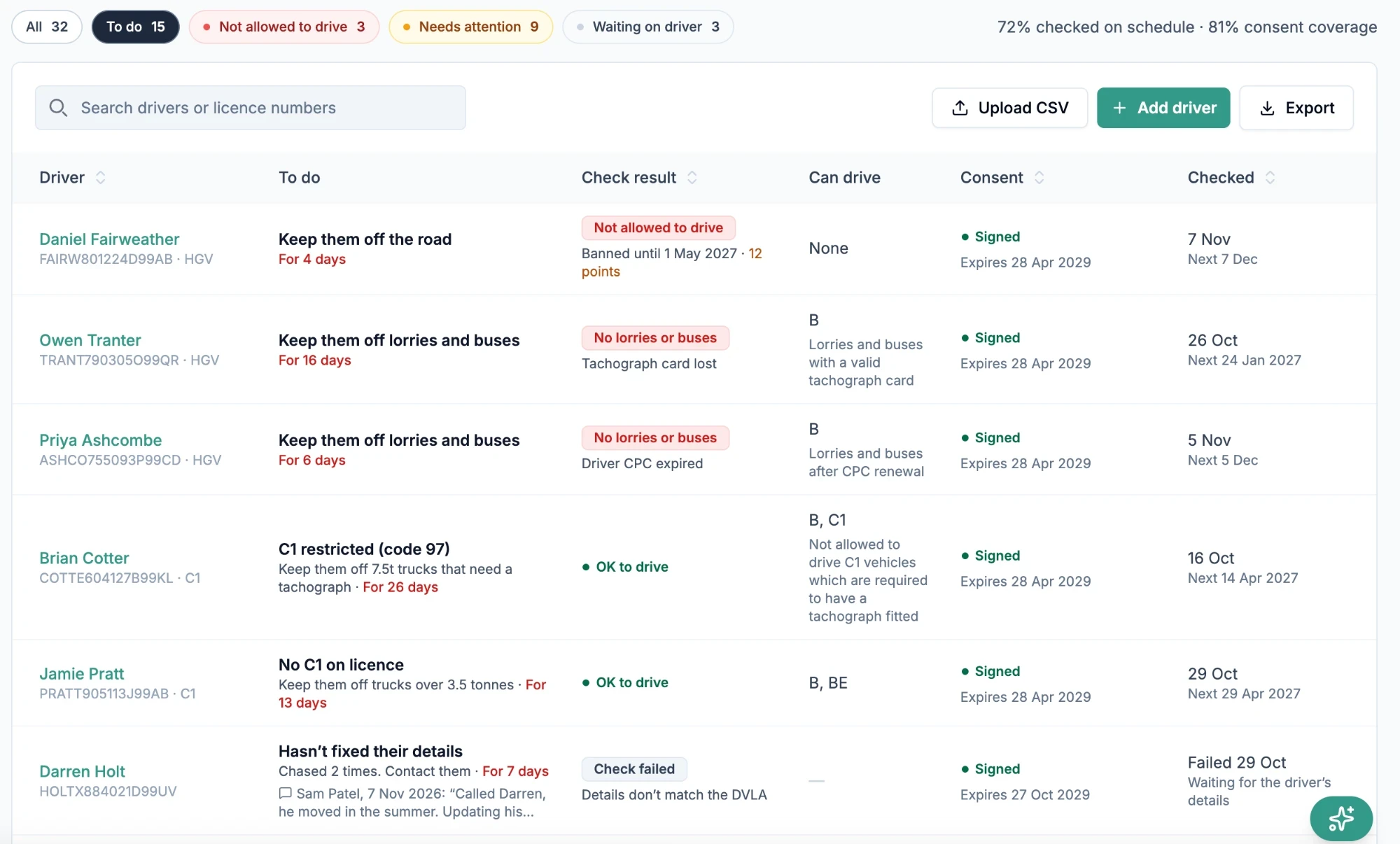
A Traffic Commissioner can suspend a lorry or bus driver's licence for a few weeks, and the whole suspension can start and finish between two of your licence checks. The driver is not obliged to tell you, and nobody else does. The Traffic Commissioners publish every driver conduct decision on GOV.UK each week, and say it is up to employers to check it.
This guide covers what driver conduct hearings are, what they can lead to, why scheduled licence checks miss them, and how to close the gap.
What a driver conduct hearing is
Traffic Commissioners decide whether professional drivers are fit to hold a vocational licence: the lorry (C1, C, CE) and bus (D1, D, DE) entitlements. A driver is usually called to a driver conduct hearing after a conviction, a roadside check by the DVSA, or another report about their conduct, such as drivers' hours or tachograph offences, or using a phone at the wheel.
At the hearing, the Traffic Commissioner can:
- give a formal warning,
- suspend the vocational entitlement for a set period,
- revoke it, and
- disqualify the driver from holding it, for a set period or indefinitely.
How long suspensions last
Many suspensions are short. Examples published by the Traffic Commissioners include:
| Offence | Outcome |
|---|---|
| Second mobile phone offence driving a lorry | 8 week suspension |
| Falsifying drivers' hours records, 3 offences | 4 weeks per offence, 12 weeks in total |
| Using a magnet or interrupter on a tachograph | Revocation and disqualification, up to 4 years in the most serious case |
A suspension only affects the vocational entitlement. The driver can still drive a car, which is one reason it goes unnoticed.
Why scheduled licence checks miss suspensions
Most operators check lorry and bus drivers every 3 months. An 8 week suspension fits comfortably between two quarterly checks:
| Date | What happens |
|---|---|
| 1 January | Quarterly licence check: clear |
| 15 January | Driver conduct hearing: 8 week suspension starts |
| 12 March | Suspension ends |
| 1 April | Next quarterly check: clear |
For 8 weeks the driver should not have driven a lorry, and both checks either side came back clean. If the driver kept working, the operator ran vehicles with a driver who was not entitled to drive them, with the insurance and operator licence consequences that follow.
The Traffic Commissioners considered telling employers about hearings in advance, and decided not to. Making drivers name their employer would need a change in the law. Instead, they publish the outcomes and leave the checking to employers: in their words, it is "incumbent on employers to make these further checks."
The published driver conduct decisions
Since June 2020, the Traffic Commissioners have published driver conduct decisions weekly on GOV.UK. The list is a spreadsheet, updated each week and covering a reporting year from April to March. For each decision it shows:
- the date of the hearing,
- the driver's name,
- their year of birth,
- the first part of their postcode, and
- the outcome.
Name, year of birth and postcode district are enough to spot a likely match with one of your drivers, but not to prove it. Treat a match as a reason to run a licence check and talk to the driver, not as a finding on its own.
How to close the gap
- Check the published list every week. Compare it with your current lorry and bus drivers by name, year of birth and postcode district.
- Recheck on a match. Run a licence check straight away, and ask the driver about the hearing.
- Make reporting a condition of the job. Put it in the contract and the driver handbook: a driver must tell you if they are called to a hearing, and of any outcome.
- Check more often as risk rises. Drivers with points, recent offences or a past suspension should be checked monthly.
- Keep the record. Note each check, each match and what you did about it. It is your evidence of due diligence if a claim or a public inquiry asks.
Operators also have their own duty to tell the Traffic Commissioner about matters that affect their good repute, which can include offences by their drivers. Knowing about a driver's hearing is part of meeting it.
#1 AI-powered fleet spend control platform
Ready to Stop Losing Money on Fleet Spend?
See how much you could save in the first week. Start your free trial today. Cancel anytime.
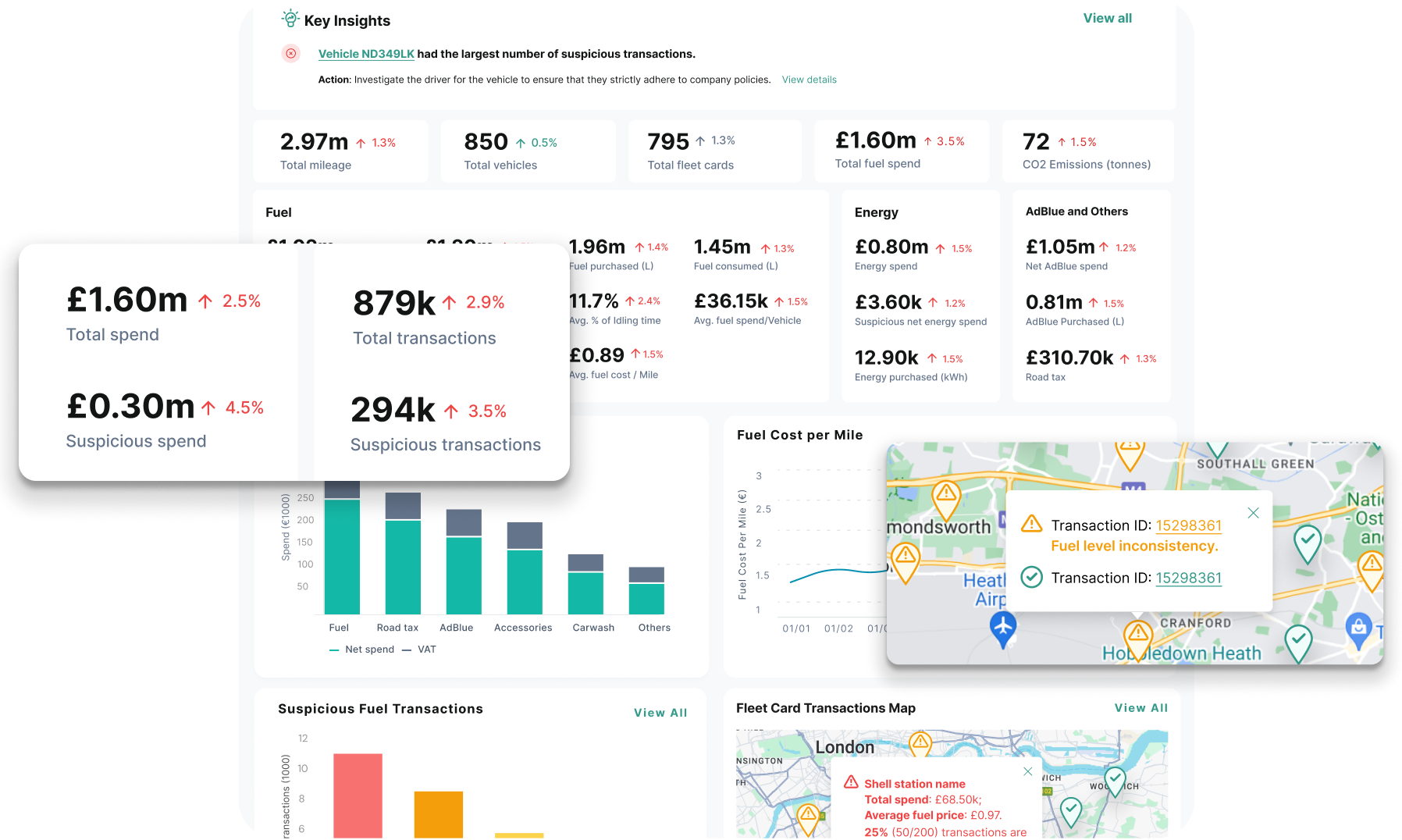
How Fleevo helps
Fleevo checks driving licences against DVLA records on a schedule you set by risk: lorry and bus drivers at least every 3 months, and monthly for drivers with more points. Each check shows the driver's entitlements, points, bans, and Driver CPC and tacho card expiry dates, and anyone not allowed to drive goes on a to-do list until someone confirms they are off the road. You can also run a check on any driver at any time, for example when a name turns up on the published conduct list. Explore Fleevo driver licence checks, or talk to us.
Driver conduct hearing FAQs
What is a driver conduct hearing?
A hearing where a Traffic Commissioner decides whether a lorry or bus driver is still fit to hold their vocational licence. It can end in a warning, a suspension, revocation or disqualification.
Will I be told if my driver has a conduct hearing?
Not directly. The Traffic Commissioners publish outcomes weekly on GOV.UK and expect employers to check them.
What details are in the published driver conduct decisions?
The hearing date, the driver's name, year of birth, the first part of their postcode, and the outcome.
How long is a typical driver conduct suspension?
Often a matter of weeks. Published examples include 8 weeks for a second mobile phone offence and 4 weeks per offence for falsified drivers' hours records.
Can a suspended lorry driver still drive a car?
Yes. A suspension of vocational entitlement covers lorry or bus categories, not the driver's car licence.
How often should I check lorry drivers' licences?
At least every 3 months, more often for drivers with points or past offences, and check the weekly driver conduct list in between.
Related: driver licence checks guide, what an operator's licence requires, drivers' hours and tachograph rules, DVSA Earned Recognition.
This is general information, not legal advice.
Sources
- GOV.UK, Vocational driver conduct statutory guidance: summary of consultation responses and outcome: https://www.gov.uk/government/consultations/vocational-driver-conduct-statutory-guidance/public-feedback/summary-of-consultation-responses-and-outcome
- GOV.UK, Traffic commissioner regulatory decisions: https://www.gov.uk/traffic-commissioner-regulatory-decisions
- GOV.UK blog (Moving On), Professional drivers meeting the conduct standards: https://movingon.blog.gov.uk/2016/10/20/professional-drivers-meeting-the-conduct-standards/
- Traffic Commissioners, Statutory Document No. 6, Vocational Driver Conduct: https://assets.publishing.service.gov.uk/media/65956a19614fa2000df3a865/Stat_Doc_6_Driver_Conduct_-_Version_11.0.pdf