
Fleet fuel economy is how efficiently vehicles turn fuel into distance. It is usually expressed as miles per gallon (MPG) or litres per 100 kilometres (L/100km), and it is one of the clearest early signals that something has changed on a route, a vehicle, or a driver, long before it shows up in the total fuel bill.
A Note on Units
MPG is not one number. A US gallon is smaller than a UK (imperial) gallon, so US MPG figures look lower than UK ones for the same vehicle. Much of the world uses L/100km instead, where a lower number is better. When comparing vehicles, always compare like with like, and ideally convert everything to a single measure such as cost per mile.
What Affects Fuel Economy
- Driving style: idling, harsh acceleration, and speed.
- Vehicle condition: tyre pressure, servicing, and load.
- Route and duty cycle: stop-start urban work versus steady motorway miles.
- Data quality: a fill logged against the wrong vehicle instantly distorts its apparent MPG.
Real-World vs Official Figures
Manufacturer economy figures come from standardized tests and rarely match real-world fleet use. What matters is your own measured economy per vehicle, trended over time, not the brochure number.
Why It Matters
A sudden drop in a vehicle's fuel economy is an early warning: a maintenance issue, a route change, a driver behaviour problem, or a fuel transaction that never belonged to that vehicle. Tracked per vehicle, it feeds directly into cost per mile and total cost of ownership.
#1 AI-powered fleet spend control platform
Ready to Stop Losing Money on Fleet Spend?
See how much you could save in the first week. Start your free trial today. Cancel anytime.
How Fleevo Uses Fuel Economy
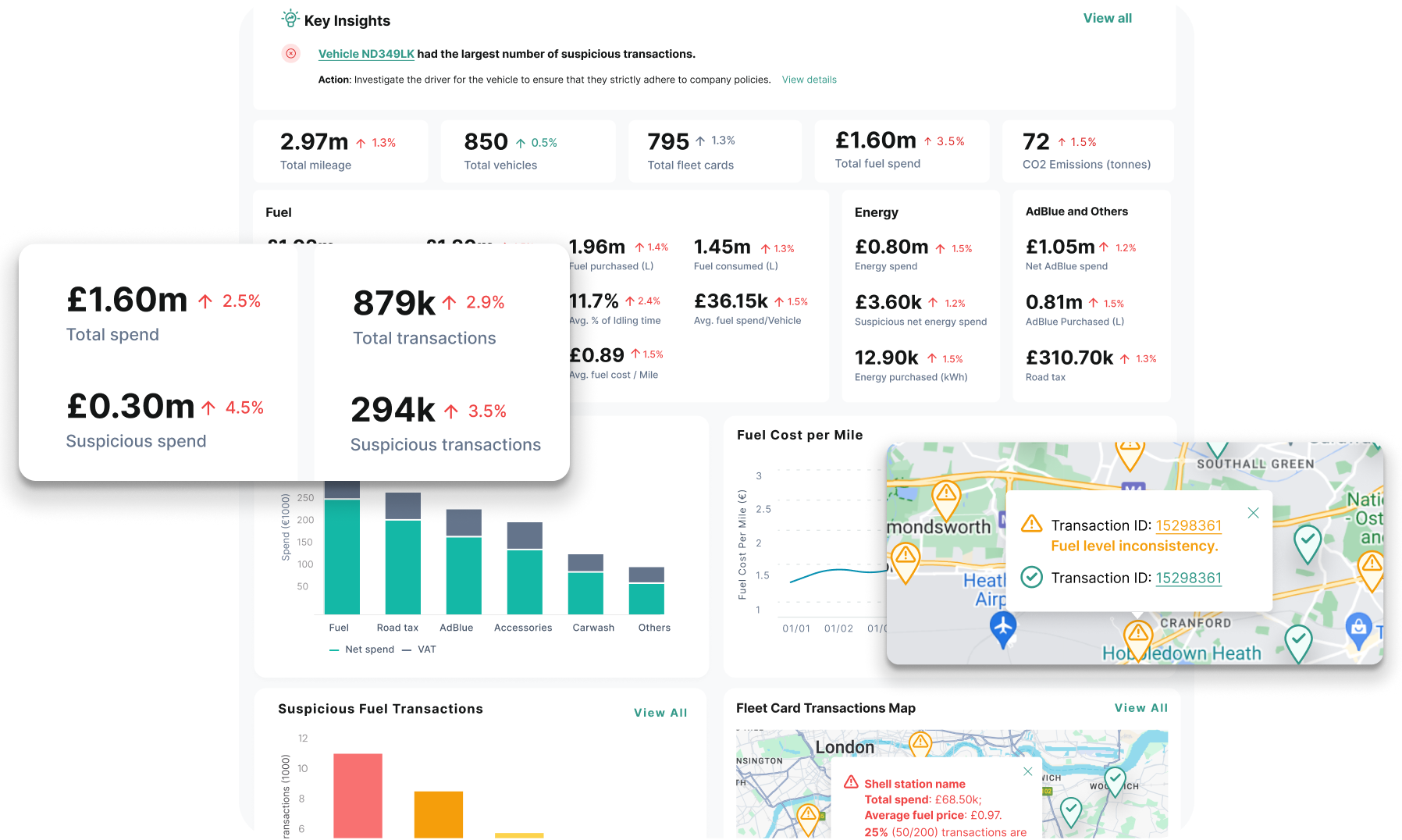
Fleevo calculates real fuel economy per vehicle from reconciled fuel and telematics data, so a distorted MPG figure points either to a genuine efficiency problem or to a fuel transaction that does not reconcile. See fleet idling costs, how to calculate cost per mile, and Fuel & Energy Management.
Fleet Fuel Economy FAQs
How is fleet fuel economy measured?
As MPG (miles per gallon) or L/100km. For fair comparison across vehicles, convert to a single measure such as cost per mile.
Why do US and UK MPG figures differ?
A US gallon is smaller than a UK imperial gallon, so the same vehicle shows a lower MPG in US units than in UK units.
What causes a sudden drop in fuel economy?
Driving behaviour, tyre or maintenance issues, a route change, or a fuel transaction wrongly attributed to the vehicle. It is a useful early warning worth investigating.
Related: fleet idling costs, fleet cost per mile, and what is fleet fuel management.