


A fleet audit sounds like something you only do when a regulator comes knocking. In practice, the fleets that run audits on their own terms are the ones that avoid fines, catch waste early, and pass official inspections without a scramble. Here is what a fleet audit actually covers, how to run one, and how to stay audit-ready year-round.
What Is a Fleet Audit?
A fleet audit is a structured review of a fleet's vehicles, drivers, records, compliance, and spend, measured against regulations, internal policies, and cost benchmarks. The goal is to confirm that what should be happening (maintenance on schedule, drivers qualified, documents current, spend accounted for) actually is, and to surface the gaps before they turn into fines, breakdowns, or losses.
Audits can be internal, run by your own team, or external, carried out by a regulator such as the DVSA in the UK or the DOT and FMCSA in the US, or by an insurer or accreditation body like FORS. A strong internal audit program means an external one holds no surprises.
What Does a Fleet Audit Cover?
A thorough fleet audit spans several areas:
- The vehicle register itself: every vehicle with registration, VIN, class, acquisition date, keeper status, and disposal date. Everything else is sampled from this list, so an inaccurate register undermines every other record.
- Compliance and documentation: vehicle registration, insurance, road tax, operator licensing, inspection and defect records, and driver hours or hours-of-service logs.
- Driver qualification: licenses, training, medicals, and drug and alcohol testing records, covering agency and grey fleet drivers as well as employed ones.
- Maintenance and safety: service intervals, inspection sheets, defect reporting and rectification, and annual test or MOT status.
- Daily walkaround checks: completed records including nil defect records, since a gap in the series is indistinguishable from a check that never happened.
- Fuel and energy: fuel card transactions, mileage, and consumption checked for fraud, misuse, and waste. See our guide to running a fleet fuel audit.
- Spend and cost: maintenance invoices, fines and penalties, and total cost of ownership per vehicle.
- Utilization: whether each vehicle is used enough to justify its cost.
- Policies and driver acknowledgements: the documents themselves, plus evidence that drivers received and accepted them.
How to Run a Fleet Audit
- Define the scope. Decide which areas and how many vehicles. A full audit covers everything above; a spot check might focus on driver files or fuel spend.
- Gather the records. Pull documents, maintenance logs, fuel data, and compliance records into one place. This is where most audits stall, because the data lives in separate systems.
- Check against the standard. Compare each record to the regulation or policy it should meet, and flag anything missing, expired, or inconsistent.
- Investigate the exceptions. A fuel transaction that doesn't match a vehicle's location, an invoice for a repair the vehicle didn't need, a license that lapsed. These are where risk and cost hide.
- Fix and document. Resolve each gap and keep a record of the correction. That trail is what proves compliance in an external audit.
- Repeat on a schedule. Comprehensive audits work best quarterly, with monthly spot checks on high-risk areas like driver files and fuel spend.
What Auditors Actually Probe
An auditor does not read everything. They sample, then follow threads, because a gap in the middle of a chain is more revealing than any single document. Four threads get pulled reliably, and they are the same four you can use on yourself:
1. Pick a vehicle and trace its whole life. Acquisition, every inspection, every defect and its rectification, current status, disposal if applicable. Missing links in the middle are the finding.
2. Pick a driver and trace their compliance record. Licence checks at the stated frequency, policy acknowledgement, hours records, any incidents. Agency and grey fleet drivers are where this usually breaks, because they are often held outside the main records.
3. Pick a reported defect and follow it to rectification. This tests whether the walkaround process is real or performative, and it is the single most revealing thread available. Most fleets can produce the defect report. Far fewer can produce what happened next.
4. Take a reported figure and reconcile it to source. Pick a fuel or mileage total from a report and ask to see the transactions behind it. If the report was assembled by hand, this is usually where it stops.
Running those four yourself, on a random sample, once a quarter takes about half a day and finds gaps while there is still time to close them.
Why Fleet Audits Matter
Beyond passing inspections, regular audits pay for themselves. Preventive maintenance planned around real vehicle use is consistently cheaper than the reactive repairs it prevents, and every vehicle-off-road day carries a direct cost in replacement hire or lost work. Auditing fuel and maintenance spend also catches the fraud and overbilling that silent, un-audited data lets slip through, and surfaces the under-used vehicles whose standing cost is not being earned back.
The Hard Part Is Audit-Ready Data
The reason audits are painful is not the checking, it is the gathering. Fuel spend sits in a card portal, mileage in telematics, repairs in a workshop's records, and fines in yet another inbox. Pulling it all together by hand, every quarter, is where the time goes. Fleets that stay continuously audit-ready do it by integrating that data so the record is always current instead of rebuilt under pressure.
Two habits make the difference. Hold one authoritative vehicle register that everything else hangs off, and attach records to the vehicle rather than to a filing process. An inspection record filed by date in a workshop folder is technically present and practically unfindable, which in audit terms is the same as absent.
#1 AI-powered fleet spend control platform
Ready to Stop Losing Money on Fleet Spend?
See how much you could save in the first week. Start your free trial today. Cancel anytime.
How Fleevo Keeps Your Fleet Audit-Ready
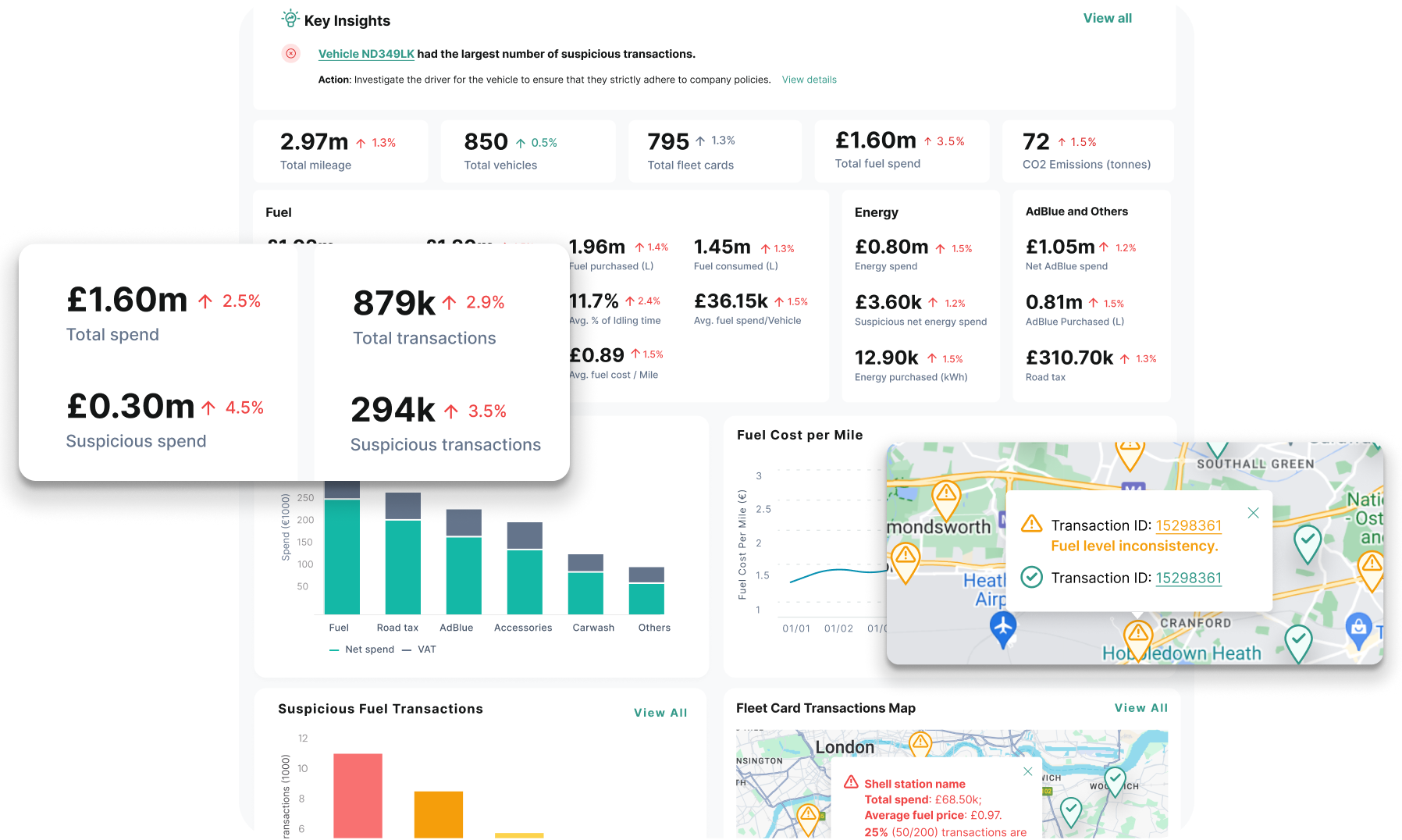
Fleevo connects the fuel cards, telematics, tanks, maintenance invoices, and fines a fleet already uses into one audited view, then checks every transaction automatically. Instead of assembling records for an audit, the audit trail builds itself: every fuel transaction cross-referenced against vehicle location, every maintenance invoice checked against usage and market rates, every fine captured and tracked to resolution. Compliance and emissions reporting generate on a schedule, so documentation stays current. That also means the fourth thread above, reconciling a reported figure back to source transactions, holds up on demand rather than only when someone has time to rebuild it. Explore Compliance & Audit Readiness and see the full total cost of ownership picture an audit-ready fleet gets.
Fleet Audit FAQs
How often should you audit a fleet?
Run a comprehensive internal audit quarterly, with monthly spot checks on high-risk areas such as driver qualification files, hours of service, and fuel spend. Continuous automated checks are better still, because they catch issues as they happen rather than months later.
What is the difference between a fleet audit and a compliance inspection?
A compliance inspection is usually external and focused on regulatory rules, such as a DVSA or DOT check of licensing, hours, and vehicle condition. A fleet audit is broader and often internal, covering compliance plus maintenance, fuel, spend, and utilization. A strong internal audit program is the best preparation for an external inspection.
What is the most common fleet audit finding?
An incomplete or inaccurate vehicle register: disposed vehicles still listed, hired vehicles missing, or registrations that do not match. Because every other record is sampled from the register, an unreliable register weakens the entire audit.
How can I audit my own fleet?
Use the same four threads an external auditor would: trace one vehicle's whole life, one driver's compliance record, one reported defect through to rectification, and one reported figure back to its source transactions. Anything you cannot complete is a finding.
How do you make a fleet audit-ready?
Keep records current and in one place. The practical way to do this is to integrate fuel, telematics, maintenance, and compliance data into a single platform, so the audit trail is always up to date rather than reconstructed under pressure before an inspection.
Bottom line: a fleet audit is not a once-a-year fire drill. Done regularly, and backed by integrated data, it keeps you compliant, catches waste early, and turns the next external inspection into a formality.
Explore the platform: Compliance & Audit Readiness and the Fleet Fuel Audit Guide.